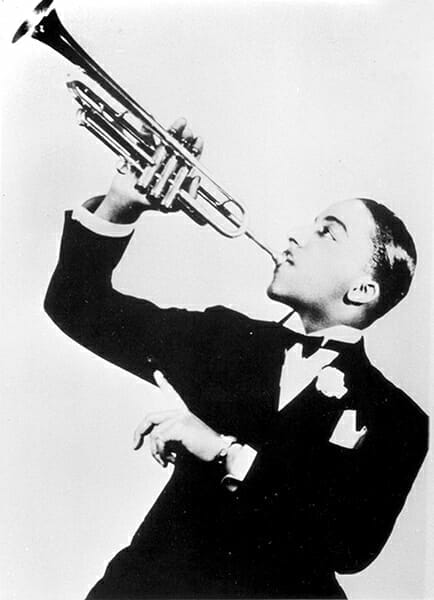
As we embark on the next Heritage Sounds transcription project, it was time that I updated my web page to reflect the newest bandleader of the moment – Erskine Hawkins! A crowd funding campaign will run now through August 2, 2024 to raise funds to transcribe enough charts for a night of dancing to Hawkins’ repertoire at Lindy Focus, then make the charts available on the Heritage Sounds website, in the hopes that people now and in the future will be able to enjoy live big band performances of this music. As always, you can contribute as little or as much as you like, rewards include sponsoring and entire song as well as some sweet swag that includes a letter jacket (in honor of Hawkins’ ‘Bama State Collegians).
We’ve only just settled on a set list and continue the deep dive into this material. I plan to profile the 11 or so vocalists who recorded with Hawkins’ orchestra, so stay tuned for more information. For now, I’d like to share with you the beginnings of the Hawkins orchestra, which, like many things, begins with a community and teachers. Infinite thanks to Burgin Mathews for his dissertation on Magic City Jazz for his UNC M.A. in Folklore, all of the following is summarized/copied in parts from his research:
John T. “Fess” Whatley was the music teacher at Industrial High School in Birmingham, Alabama, beginning in 1917 as a 21-year-old printing teacher. He built a school band from scratch, with donated instruments and some purchased himself out of a portion of his salary. They would practice on weekends and before/after school and, after 5 months, played their first concert. This and subsequent concerts were such a resounding success with the Black community that, by end of 1918 school year, the school had built an outdoor bandstand to showcase the band and accommodate the needs of the community. After the school band got going, Whatley and other educators added regular “Community Sings,” almost a variety show of local musical and poetic/oratory talent. Band soon became a trade at the high school, not an extracurricular, and it was arguably a more rigorous field of study than other trades at the school, as, in addition to 1/3 of classroom time, students had before/after school and weekend rehearsals, performances, parades, assemblies, dances, and other events/obligations as part of their training. Music was a trade with a path to a middle class income, on par with teaching and ministry, and potentially a ticket to a big city.
Fess Whatley was a trumpet player with a distinct, crisp tone, musical precision, and exacting standards, so it is no surprise that his instruction gave rise to what became the Erskine Hawkins Orchestra. He led Birmingham’s first jazz orchestra, the 10-piece Jazz Demons, starting in 1921. So many people wanted to be trained by Whatley that he had to turn people away. Students graduated and went all over the US and to such faraway places as the Taj Mahal Hotel in India to lead the band there. In addition to Erskine Hawkins gaining national fame, alumni include bandleaders Teddy Hill and Sun Ra.
“At Alabama State Teachers College in Montgomery, three popular jazz bands—the ’Bama State Collegians, the ’Bama State Revelers, and the ’Bama State Cavaliers—became popular touring acts during the Great Depression, raising money for their school wherever they went. During the Second World War, the directors of Army, Navy, and Air Force bands similarly looked to Birmingham for recruits. At the Tuskegee Army Air Field, Whatley musicians helped fill the ranks of the 313th Army Air Force Band and a swinging orchestra, the Imperial Wings of Rhythm.”
The school band’s uniform was, of course, a tuxedo. Allegedly, King Edward VII originated the tuxedo jacket because he requested of his Saville Row tailor something more dressy than a lounge suit, but less formal than a tailsuit. The word tuxedo comes from the Lenni-Lenape Native American tribe, who were allegedly called Tuxedo (meaning “he has a round foot” (which may be in reference to the wolf), “place of the bear” or “clear flowing water”) by their enemies the Algonquins. The Lenni-Lenape lived near a lake which they named “Tucseto,” which later became known as Tuxedo Lake, and the area where they lived was called Tuxedo. In 1885, Pierre Lorillard IV developed a piece of land his grandfather owned in Tuxedo for a summer resort for the wealthy and well-to-do, naming it Tuxedo Park. He then “organized the Tuxedo Club and the Tuxedo Park Association, as hunting and fishing preserve (and society), and surrounded the property with a high game fence. In 1886, he built a club house,” which hosted a number of formal events where the tuxedo jacket became popular, likely a function of the resort and the feeling that it was acceptable to “dress down” (as compared to donning a tailcoat every night). By the time Whatley was leading bands in tuxedos, the ensemble was ubiquitous as the epitome of class and sophistication.
Whatley prioritized sight-reading and playing multiple instruments, to ensure that a musician could jump on a bandstand without rehearsal and so that the musician could fill as many chairs as possible for maximum employment potential. If you told someone you were from Birmingham, they knew you could read and this gave Birmingham musicians an edge in hiring, often without an audition. Whatley did not allow improvisation – what this did was prioritize fundamentals. Learn the rules so you can break them.
Whatley paid his students for their arrangements, incentivizing the creation of charts to build the band’s book and to help his students develop this valuable skill. Hawkins’ band always had at least two arrangers on staff, contributing charts. Whatley’s student Amos Gordon went on to become Louis Armstrong’s arranger in the 1940s.
A noticeable impact on the Hawkins orchestra, outside of the ensemble’s tightness, was the sheer volume of “sweet” arrangements I’ve encountered in reviewing this material, perhaps created or honed from the arrangers’ high school days at Industrial. I also wonder how much of an impact Birmingham’s music taste had on Hawkins’ decision to record so many sweet tunes.
Whatley’s Jazz Demons gained a regional reputation for Birmingham, starting out playing more improvisational, New Orleans style in the 1920s; then evolved into a 14 piece band, the Vibra-Cathedral Orchestra, playing more arranged music in the 1930s; then a full big band Sax-o-Society Orchestra in the 1940s. His band was comprised of his own former and current students. They were booked out months to a year in advance and, if they weren’t available, the high school band would often take its place. Whatley’s students left with knowledge of a vast repertoire of standards, stomps, trad jazz, sweet music, blues, swing, spirituals – they played music from the entire history of jazz.
This is the foundation for Erskine Hawkins’ orchestra – a seasoned group of musicians from this Birmingham jazz tradition, professional performers since their high school years, with a reputation for excellence preceding them and the heights of the swing era to raise them into the national spotlight.
The lineup of the Hawkins orchestra remained almost intact for recordings from July 1936 through the end of 1938, with one tenor saxophone substitution and one vocalist. After that, the next substitution was guitar and another vocalist in October of 1939; guitar again in February 1940; then in June 1940, a trumpet sub, but then we’re back to the original tenor sax player, Paul Bascomb, who subbed out in 1938; then in November 1940 the original trumpet player who subbed out, Wilbur Bascomb, came back, leaving the orchestra with the same lineup for 4+ straight years with the exception of guitar and female vocalist. The orchestra was more than just a band, it was community.
In July 18, 1939, when the band recorded Tuxedo Junction for RCA Victor in New York, it was more than just a song, it was foundational to their home, their training, their music family.
We’d like to welcome Erskine Hawkins to the Lindy Focus family and invite dancers to Lindy Focus on December 30 dance to 30 or so Savoy Ballroom-vetted numbers and hear more about the history of this orchestra from our bandleader, Jonathan Stout; invite musicians and bandleaders to dive into these charts once they are created and share this music with the world; and invite all of you to drop a few dollars in the virtual collection jar, because the only way we keep making these projects a reality is through our mutual love of swing era jazz and the dances it inspired.


 It’s live! This year’s
 I’ll be Knoxville-bound soon enough, but this is an extra special weekend because
  In the second installment of transcribing arrangements for an entire night dance music from one swing era bandleader, Jimmie Lunceford is on deck and the
  Laura Windley