As we embark on the next Heritage Sounds transcription project, it was time that I updated my web page to reflect the newest bandleader of the moment – Erskine Hawkins! A crowd funding campaign will run now through August 2, 2024 to raise funds to transcribe enough charts for a night of dancing to Hawkins’ repertoire at Lindy Focus, then make the charts available on the Heritage Sounds website, in the hopes that people now and in the future will be able to enjoy live big band performances of this music. As always, you can contribute as little or as much as you like, rewards include sponsoring and entire song as well as some sweet swag that includes a letter jacket (in honor of Hawkins’ ‘Bama State Collegians).
We’ve only just settled on a set list and continue the deep dive into this material. I plan to profile the 11 or so vocalists who recorded with Hawkins’ orchestra, so stay tuned for more information. For now, I’d like to share with you the beginnings of the Hawkins orchestra, which, like many things, begins with a community and teachers. Infinite thanks to Burgin Mathews for his dissertation on Magic City Jazz for his UNC M.A. in Folklore, all of the following is summarized/copied in parts from his research:
John T. “Fess” Whatley was the music teacher at Industrial High School in Birmingham, Alabama, beginning in 1917 as a 21-year-old printing teacher. He built a school band from scratch, with donated instruments and some purchased himself out of a portion of his salary. They would practice on weekends and before/after school and, after 5 months, played their first concert. This and subsequent concerts were such a resounding success with the Black community that, by end of 1918 school year, the school had built an outdoor bandstand to showcase the band and accommodate the needs of the community. After the school band got going, Whatley and other educators added regular “Community Sings,” almost a variety show of local musical and poetic/oratory talent. Band soon became a trade at the high school, not an extracurricular, and it was arguably a more rigorous field of study than other trades at the school, as, in addition to 1/3 of classroom time, students had before/after school and weekend rehearsals, performances, parades, assemblies, dances, and other events/obligations as part of their training. Music was a trade with a path to a middle class income, on par with teaching and ministry, and potentially a ticket to a big city.
Fess Whatley was a trumpet player with a distinct, crisp tone, musical precision, and exacting standards, so it is no surprise that his instruction gave rise to what became the Erskine Hawkins Orchestra. He led Birmingham’s first jazz orchestra, the 10-piece Jazz Demons, starting in 1921. So many people wanted to be trained by Whatley that he had to turn people away. Students graduated and went all over the US and to such faraway places as the Taj Mahal Hotel in India to lead the band there. In addition to Erskine Hawkins gaining national fame, alumni include bandleaders Teddy Hill and Sun Ra.
“At Alabama State Teachers College in Montgomery, three popular jazz bands—the ’Bama State Collegians, the ’Bama State Revelers, and the ’Bama State Cavaliers—became popular touring acts during the Great Depression, raising money for their school wherever they went. During the Second World War, the directors of Army, Navy, and Air Force bands similarly looked to Birmingham for recruits. At the Tuskegee Army Air Field, Whatley musicians helped fill the ranks of the 313th Army Air Force Band and a swinging orchestra, the Imperial Wings of Rhythm.”
The school band’s uniform was, of course, a tuxedo. Allegedly, King Edward VII originated the tuxedo jacket because he requested of his Saville Row tailor something more dressy than a lounge suit, but less formal than a tailsuit. The word tuxedo comes from the Lenni-Lenape Native American tribe, who were allegedly called Tuxedo (meaning “he has a round foot” (which may be in reference to the wolf), “place of the bear” or “clear flowing water”) by their enemies the Algonquins. The Lenni-Lenape lived near a lake which they named “Tucseto,” which later became known as Tuxedo Lake, and the area where they lived was called Tuxedo. In 1885, Pierre Lorillard IV developed a piece of land his grandfather owned in Tuxedo for a summer resort for the wealthy and well-to-do, naming it Tuxedo Park. He then “organized the Tuxedo Club and the Tuxedo Park Association, as hunting and fishing preserve (and society), and surrounded the property with a high game fence. In 1886, he built a club house,” which hosted a number of formal events where the tuxedo jacket became popular, likely a function of the resort and the feeling that it was acceptable to “dress down” (as compared to donning a tailcoat every night). By the time Whatley was leading bands in tuxedos, the ensemble was ubiquitous as the epitome of class and sophistication.
Whatley prioritized sight-reading and playing multiple instruments, to ensure that a musician could jump on a bandstand without rehearsal and so that the musician could fill as many chairs as possible for maximum employment potential. If you told someone you were from Birmingham, they knew you could read and this gave Birmingham musicians an edge in hiring, often without an audition. Whatley did not allow improvisation – what this did was prioritize fundamentals. Learn the rules so you can break them.
Whatley paid his students for their arrangements, incentivizing the creation of charts to build the band’s book and to help his students develop this valuable skill. Hawkins’ band always had at least two arrangers on staff, contributing charts. Whatley’s student Amos Gordon went on to become Louis Armstrong’s arranger in the 1940s.
A noticeable impact on the Hawkins orchestra, outside of the ensemble’s tightness, was the sheer volume of “sweet” arrangements I’ve encountered in reviewing this material, perhaps created or honed from the arrangers’ high school days at Industrial. I also wonder how much of an impact Birmingham’s music taste had on Hawkins’ decision to record so many sweet tunes.
Whatley’s Jazz Demons gained a regional reputation for Birmingham, starting out playing more improvisational, New Orleans style in the 1920s; then evolved into a 14 piece band, the Vibra-Cathedral Orchestra, playing more arranged music in the 1930s; then a full big band Sax-o-Society Orchestra in the 1940s. His band was comprised of his own former and current students. They were booked out months to a year in advance and, if they weren’t available, the high school band would often take its place. Whatley’s students left with knowledge of a vast repertoire of standards, stomps, trad jazz, sweet music, blues, swing, spirituals – they played music from the entire history of jazz.
This is the foundation for Erskine Hawkins’ orchestra – a seasoned group of musicians from this Birmingham jazz tradition, professional performers since their high school years, with a reputation for excellence preceding them and the heights of the swing era to raise them into the national spotlight.
The lineup of the Hawkins orchestra remained almost intact for recordings from July 1936 through the end of 1938, with one tenor saxophone substitution and one vocalist. After that, the next substitution was guitar and another vocalist in October of 1939; guitar again in February 1940; then in June 1940, a trumpet sub, but then we’re back to the original tenor sax player, Paul Bascomb, who subbed out in 1938; then in November 1940 the original trumpet player who subbed out, Wilbur Bascomb, came back, leaving the orchestra with the same lineup for 4+ straight years with the exception of guitar and female vocalist. The orchestra was more than just a band, it was community.
In July 18, 1939, when the band recorded Tuxedo Junction for RCA Victor in New York, it was more than just a song, it was foundational to their home, their training, their music family.
We’d like to welcome Erskine Hawkins to the Lindy Focus family and invite dancers to Lindy Focus on December 30 dance to 30 or so Savoy Ballroom-vetted numbers and hear more about the history of this orchestra from our bandleader, Jonathan Stout; invite musicians and bandleaders to dive into these charts once they are created and share this music with the world; and invite all of you to drop a few dollars in the virtual collection jar, because the only way we keep making these projects a reality is through our mutual love of swing era jazz and the dances it inspired.
As we are in the midst of a fourth crowd-funding campaign to transcribe and make available the charts of Black bandleaders and their bands from the swing era, with Al Cooper and the Savoy Sultans as the band for 2023, I wanted to take a moment and highlight the importance of this work and the legal hurdles that often prevent this music from being more widely available and prevent these venerable musicians from being better known by the public. United States copyright law has catered to corporations and their lobbyists (particularly a certain dynastic purveyor of cartoon princesses, endearingly silly critters, and acquirer of a certain multiverse), extending the copyright term well beyond what is beneficial to the artist, focusing on corporate ownership, to the detriment of the public domain. We are dancers of historic American vernacular dances, some approaching an age that would be considered antique if a piece of furniture, and yet we struggle for this music to be available for live performance, competition videos on YouTube, and other media that would benefit from this music being in the public domain.
As a broad generality, for works created after January 1, 1978, copyright protection lasts for the life of the author plus 70 years. Contrast this with Article I, Section 8, Clause 8 of the United States Constitution: “[The Congress shall have Power . . . ] To promote the Progress of Science and useful Arts, by securing for limited Times to Authors and Inventors the exclusive Right to their respective Writings and Discoveries.” In 1790, Congressmen interpreted this to mean 14 years with a potential 14 year renewal, for a total of 28 years. I won’t go into the details of how we went from 14 years to a life (which continues to get longer as medical science evolves) + 70 years, but the only limitation is Congress’s willingness to make the term itself as a limitation (as opposed to copyright in perpetuity), not that the time is particularly limited in its duration
At this point, almost all of the music from the swing era is controlled by corporations and very little of the money is actually going to the artist’s family. None of these artists are alive.
When we embarked on the first transcription project in 2016, to create enough charts for a night of live music and dancing to the Chick Webb Orchestra’s songbook at Lindy Focus, I knew it would be a lot of work to obtain licenses to be able to subsequently publish the sheet music for 30+ songs on the Heritage Sounds website. I did not anticipate the extent of what this meant and how difficult this particular music would be to license. Here is an overview of the steps I took to obtain these licenses:
1. Research the copyright – determine who wrote the song and whether that song is still under copyright. For works published or registered between 1923 and 1977, the maximum copyright duration is 95 years from the date of publication, if copyright was renewed during the 28th year following publication. Since it was 2016 at the time I started this research, if it was written before 1923, the assumption was that the song is in the public domain; if 1923 or after, the assumption was that it was under copyright. When 2019 rolled over, the public domain date went up to 1924 and has continued to proceed without corporate pressure for Congress to enact a new copyright extension. We are now up to works published prior to January 1, 1928 having come into the public domain. The Music Modernization Act is supposed to create a database to help with this kind of research, but since that is still only a concept at this point (that I’m aware of), I would dig through the usual websites to try to determine the creator of the work. I usually start with the Harry Fox database, then move on to ASCAP and BMI, then I do internet searches if those sources fail. Sometimes the liner notes on CDs or records will have helpful information. As of the writing of this blog post, my most recent research found that ASCAP and BMI have combined their searches, so I can use the ASCAP search for both and not have to input queries into two separate websites.
2. Locate the entity that does the music publishing licensing – this is probably the most frustrating part. Start with the databases at Hal Leonard and Alfred Music – between these two companies, it’s likely that most of what you are seeking to license is controlled by one of these two companies. If the song you are researching is not in either of these databases, you will have to track it down – no one ever posts information about who does their music publishing licensing, but there is usually information available about who controls the mechanical licensing. This means that I am web-form-submitting, emailing, and/or calling (or all three) and leaving a message asking who does the music publishing licensing. Be persistent, someone in these big conglomerates has this information, you just have to figure out who.
3. Determine the parameters of your license – keep in mind that the copyright holder takes 50% of the sales price and, in most cases, the licensee has to pay that 50% upfront for the number of copies you are seeking to obtain permission to sell. It is difficult to figure out how many copies you plan to sell, but more often the consideration is what you can afford in terms of the number of licenses. Sometimes the licenses will require an annual or bi-annual accounting, but those licenses are in the minority. Sometimes these middlemen will put a time frame on the license, to incentivize you to sell your copies within that time frame. A license for digital copies is more cost-effective than a license for paper copies. You will probably want to limit the scope of your selling, for the purposes of obtaining licenses, to the US, as international distribution is likely to cost more. The cost is determined by the market and whatever you negotiate – we wanted to keep the cost of the charts pretty low, so I researched charts on several websites and arrived at $30/chart (as compared to the Essentially Ellington charts at $50 a pop).
Her hopeful face glazed over as she was sent to yet another voicemail inbox…
4. Request a license – Hal Leonard and Alfred Music have online web forms where you submit your request. Others you will have to email with your information – tell them you want a license for X song, written by Y composer(s), to sell Z number of copies priced at $ to sell digital copies in the US. That should be enough to get the ball rolling. The important thing to note is that they don’t have to give you a license – unlike bands who record cover songs, there is no compulsory license for sheet music publishing rights. Heritage Sounds has definitely been denied publishing rights, which seems wild given that licensees are paying up-front for most of these licenses – why would copyright owners refuse cash in hand? Everyone except Hal Leonard has granted me the licenses I have sought on behalf of Heritage Sounds. Though Hal has given us some licenses, they have tended to keep everything at arm’s length, while everyone else I have encountered has been personable, helpful, and responsive to my questions as I navigated this terrain. The time frame varies – sometimes I can get a license within a few weeks; typically, it has taken Hal Leonard 6 months or longer to even respond to my initial request (even though their website lists a much shorter time frame). I still have many outstanding inquiries that have received no response, from Hal Leonard and others, over the course of the three prior transcription projects (Jimmie Lunceford, Lionel Hampton, and the aforementioned Chick Webb).
5. Review license carefully – read the agreement carefully to ensure you aren’t signing too many rights away to someone and don’t be afraid to ask questions. Most of these companies have a standard license; in some cases, I have had to draft my own. Once the license is executed, review the terms again and make notes about any actions you need to take, such has time frames for licensing or accounting, notice requirements for what information you need to put on the published sheet music, etc. Managing these licenses, their different time tables, payees, methods of payment, etc. is a meticulous, time-consuming task, one that we should all thank Jaya Dorf for managing.
6. Not every song can be found – sometimes there’s nothing. Sometimes there’s partial information, but not enough to connect you with a composer, lyricist, and/or copyright holder. Sometimes there’s conflicting information. In these instances, I advised the group to hold the owner’s 50% portion of sales for these songs in escrow, should a copyright owner surface.
Patience and organization are key – there was definitely a tracking spreadsheet updated every time I sat down to work on these licenses. Each year builds on the next, as the previously negotiated licenses expire and you may need to seek a renewal, which involves more waiting and creates more work to maintain a catalog of charts.
At this point, I have put in close to 100 hours of work on this project. If you were to pay an attorney do this work and that attorney received the same hourly rate that my employer at the time charged clients for my services, that comes out to $30,000. With Heritage Sounds recouping $15 per chart sold, that would mean having to sell more than 2,000 charts (because taxes) to pay for the legal services to keep this project running. The math does not add up for this to be anything but a labor of love.
But we do love this music and have a mission to make it more accessible for live performance. This music should be celebrated, for its exuberance, its creativity, as a historical marker, and for its contribution to the genre of jazz and other art forms. I wish that more of this licensing money would go to people of color, rather than the corporations who have the resources to either buy out these catalogs (and, in many cases, sit on them) or, as often occurred in the swing era, swindle/negotiate/steal the copyright from the artists creating these works (I’m looking at you, Irving Mills, and everyone who took advantage of Fats Waller when he needed money for alimony). My hope is, as this music slowly comes into the public domain in the next couple of decades, that the focus will remain on the contributions of Black jazz musicians, lyricists, arrangers, and bandleaders; that history will represent them as at least as significant as their white contemporaries; and that we will find more ways to ensure that our resources lift up the Black voices of the swing era.
So where do we go from here with Heritage Sounds? We’ll have to take it one year at a time, one project at a time. We started with a lot of ambition, but the amount of work and the global pandemic slowed things down a bit. Whatever happens, I’ll be along for the ride.
Photograph from Open Durham of the Durham Armory in 1950 – the site of the Bull City Swingout’s Saturday night main dance and many, many swing era performances.
In anticipation of the Bull City Swingout coming up the second weekend in July, 2019, I sought out information about early jazz and swing in Durham, North Carolina – I found that there was no anthology I could direct people to and the information I could find seemed to be incomplete snippets I had discovered over the years across the internet. This blog post is an attempt to compile some of this information, with a focus on jazz dance music, and I hope that I can add to this post as I find new information about Durham’s earlier jazz history and about its later jazz history that may be tied to the jazz age and swing era. Also, here’s a map I’ve compiled with the locations mentioned herein and brief notes on the significance of each pin.
A million thanks to Open Durham for being the consummate historian and source for a lot of this information (either directly or helping to make connections) and many of the Durham photographs. Thanks also to my fellow RDU swing DJs Sarah Ovenall, Ken Hanson, and Kirk Eisenbeis for your assistance and additions to the spreadsheet that launched this post.
I’m also going to give a content warning for racism – while Durham was a vibrant hub for music and dancing during the swing era, racism and segregation were a prevalent part of the lives of locals and touring musicians. During my research into this topic I came across multiple sources that reference and/or illustrate the overt racism that existed in Durham during the jazz age and swing era. Some of this racism is referenced in this post and some of it appears in the linked source material.
Photograph from Open Durham
RAGTIME ERA/PRE-JAZZ
Because jazz didn’t come to us in a vacuum, I can see evidence that brass band music was present in this tobacco town early on. We can see that the Durham Hosiery Mill (803 Angier Ave.) had a brass band, take note of the instrumentation, and make some assumptions about the music in 1910.
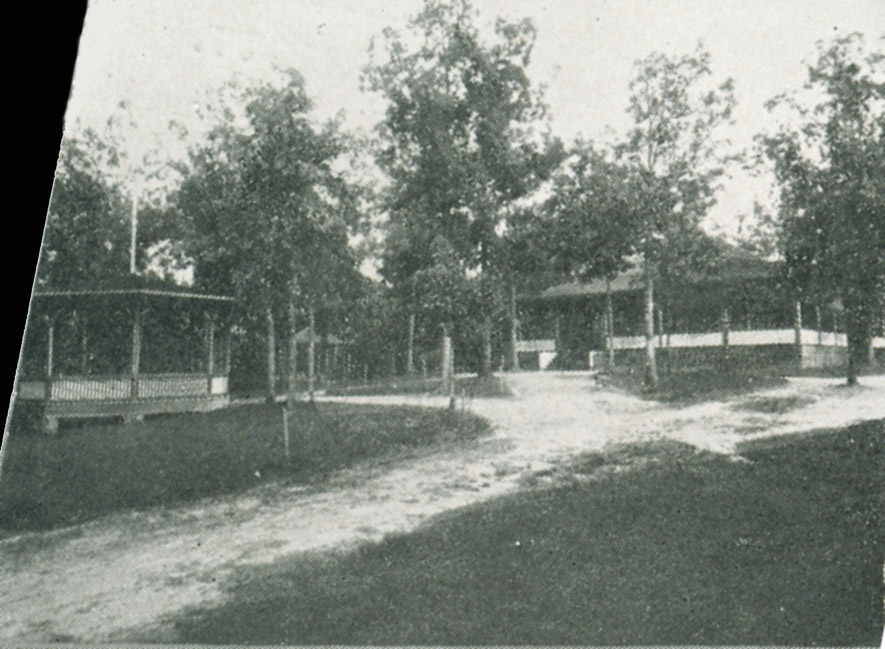
There’s also evidence of dance orchestras in existence and/or playing in Durham during the pre-jazz era. From 1902 to 1932, Durham was home to the Lakewood Amusement Park (2000 Chapel Hill Road), which held many attractions including a dance pavilion. From Open Durham: “Across from the skating rink was the pavilion, another large building, which called the Dance Hall by some. The sides were open, and typically an orchestra or band was playing; orchestras came from all over to perform while the crowds danced the night away. Joe King’s orchestra was a popular act. Other people would sit around on benches and just listen to music.”
Lakewood Amusement Park’s gazebo (left) and dance pavilion (right) – photograph from Open Durham
PIEDMONT BLUES
A studio portrait of Blind Boy Fuller, from Wikipedia
I would be remiss if I did not touch on Piedmont Blues as an essential part of the music and dance history of this area, with the style roughly originating in the 1920’s. Piedmont Blues is usually distinguished from Delta Blues by its ragtime based rhythms. Durham became an important center of blues culture, with the tobacco industry drawing rural Black people to the city with higher wage jobs and with Durham already established as an African-American business and financial center. Durham drew Blind Gary Davis in the mid-1920’s and Blind Boy Fuller in 1929 (two of the most famous Piedmont blues musicians, who incidentally made it onto the state historic plaque here in town), who would play house parties and on Pettigrew Street near the tobacco warehouses, along with Alden “Tarheel Slim” Bunn, Richard and William Trice, Floyd Council and other musicians who would contribute to the development of this art form. By the mid-1930’s the best of these musicians were playing clubs and making records. Durham had a thriving Piedmont Blues scene throughout the 1930’s until it started to see a decline in the 1940’s. Piedmont blues remains a tradition in this area and Durham is host to a blues festival, the Hayti Blues and Roots Celebration (formerly the Bull Durham Blues Festival).
Of course dancing is also part of the Piedmont Blues tradition, with a percussive dance people call flat-footing or buck dancing. The videos I keep coming back to to watch are from 1983, filmed on Algia Mae Hinton‘s porch at her home in Johnston County, which feature Hinton (one of the wonderful bridges to the past who is, unfortunately, no longer with us) dancing, John Dee Holeman (another luminary, who will turn 90 on April 4, 2019) dancing and playing guitar. There are a bunch of these videos on Hinton’s porch in the Alan Lomax Archive on YouTube. They are so great, we are lucky to have them as source material.
EARLY JAZZ AND SWING AT DUKE
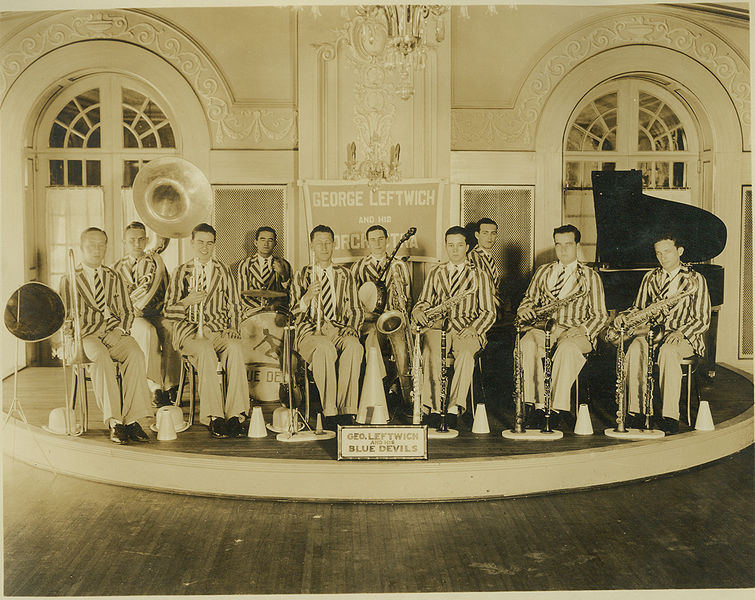
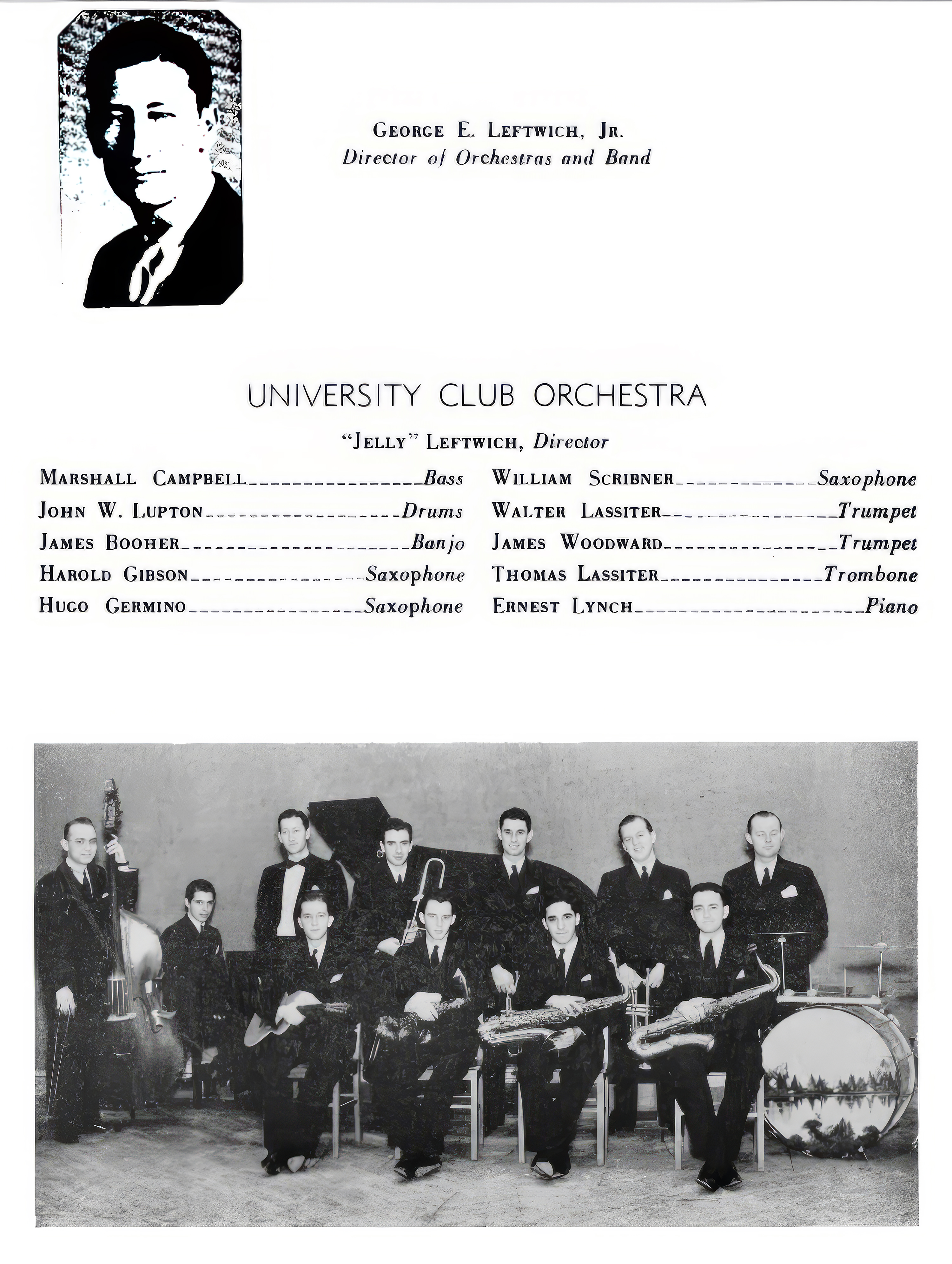
From 1926 to 1932, George “Jelly” Leftwich was the band director of Duke University, but his most popular ensemble was the jazz orchestra he formed, which I’ve seen referenced as the Duke University Club Orchestra, George Leftwich and his Blue Devils, and the Duke University Blue Devils. At a community performance at Durham High School (now Durham School of the Arts, 400 N. Duke Street), the Duke Chronicle reported that the band played “Who,” “Tiger Rag,” and “Stumbling.”
1926, the year Leftwich started working at Duke as its first director of music, was a notable year, as the student population demanded more dancing and dance music – the student body voted 704 to 6 in favor of on-campus dancing, in an attempt to sway the Methodist-affiliated university’s administration concerning the no dancing on campus policy. Perhaps the timing of this vote and the hiring of Leftwich/formation of the jazz orchestra were intentional, coincidental, or perhaps one bolstered the other. Ultimately, the student body won out and dancing to both recorded and live music became an on-campus activity.
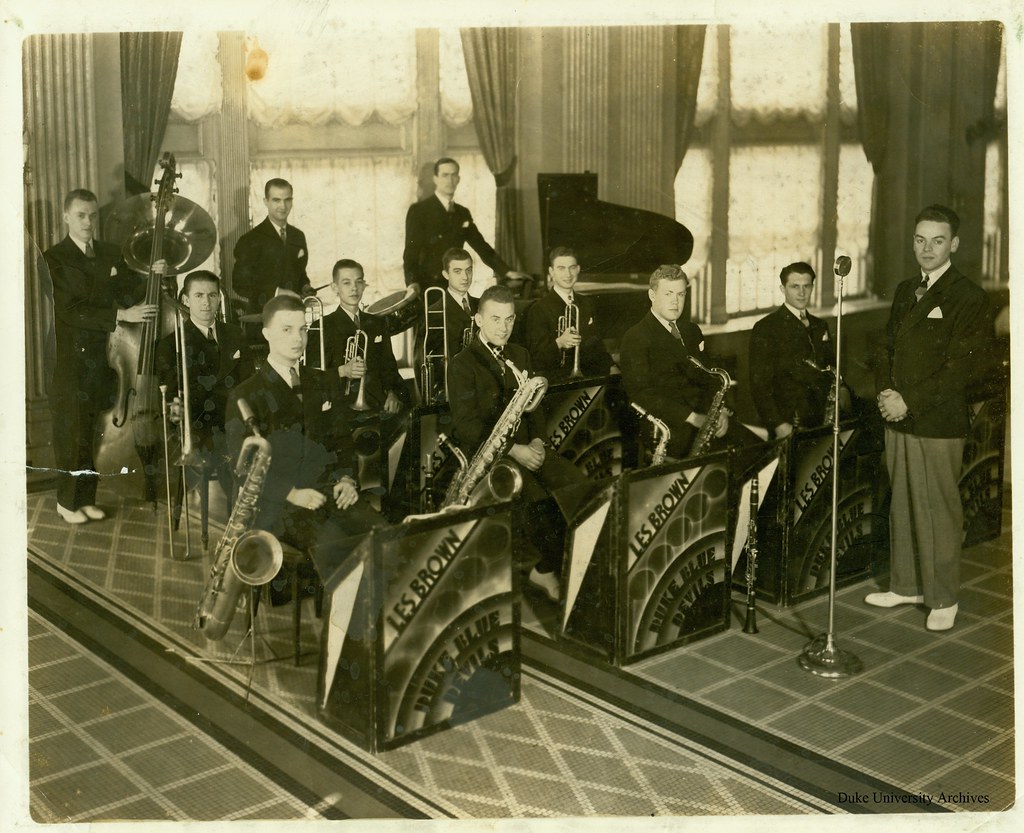
My sources say this photograph of George Leftwich and his Blue Devils was probably taken in the East Duke building – from the Duke University Archives.
On Duke’s campus during the Great Depression, student financial constraints meant that they couldn’t always make it to whatever entertainment was available downtown, so they made their own. A gymnasium built in 1898 (nicknamed “The Ark“) was converted to more multipurpose dancing space by the Social Standards Committee of the Woman’s Student Government, who paid to have the floor refinished, purchased a radio/Victrola, and hosted bands every Saturday night and one Wednesday night per month. In 1931, Duke University constructed the West Campus Union building, which also housed a popular ballroom where bands performed.
While Jelly Leftwich was successful at directing bands for Duke, his success also inspired students to start their own bands, such as the Duke Collegians (founded in 1931), Nick “the Crooning Half-back” Laney and his Blue Devil Orchestra (founded in 1932), Sonny Burke and The Duke Ambassadors (founded in 1934), and other swing bands such as the Swing Kings, Blue Dukes, Blue Imps, Grand Dukes, and the D-Men. Laney’s band went on a summer tour of the northeast in 1932 and while on the road met an up-and-coming saxophone player named Les Brown and convinced him to come to Duke instead of the University of Pennsylvania.
In 1933, Brown took over leadership of the Blue Devils after Laney graduated. Under Brown’s direction (while still a student), the Blue Devils performed regularly on campus and toured throughout the east coast, with their tour in 1936 being particularly successful. They were signed by Decca Records and recorded in the fall of 1936, but disbanded the following year. Brown moved to New York (with some of the Blue Devils coming with him to form the Band of Renown) and the rest is history.
Photograph from the Duke University Archives
A final swing era note that occurred later in Duke’s history, from 1977 until her death in 1981, jazz pianist, composer, arranger, and all around badass Mary Lou Williams was a professor at Duke and led the Duke Jazz Ensemble (this was not Williams’ first experience in Durham, however – we’ll return to this later). In 1983, Duke established the Mary Lou Williams Center for Black Culture (404 Chapel Drive) which (among many other things) continues to host jazz performance series Jazz @ The Mary Lou.
SWING ERA – TOURING ACTIVITY
Was “In a Sentimental Mood” composed here? Photograph from Open Durham
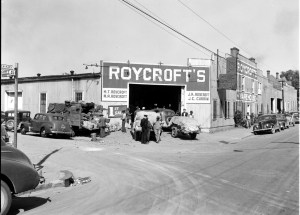
Duke Ellington has a history of performing in Durham, with the earliest show I could find on record occurring on July 22, 1934 with his orchestra at Banner Warehouse (216-220 W. Morgan St.), roughly where the YMCA and Mr. Tire are located today. He returned on March 13, 1935, to play a show at the Roycroft Warehouse (401 Rigsbee Ave.) from 9 p.m. to 1 a.m. (according to the Norfolk Journal and Guide published on March 9, 1935). As the legend goes, in 1935 Ellington composed “In a Sentimental Mood” at a performance at a party hosted by the NC Mutual Life Insurance Company, composed spontaneously to calm the mood after one of his friends got in a quarrel with two women at the party. The only record I can find of him performing in Durham in 1935 is this March 13, 1935 date, so it may be that this jazz standard was written in a Durham tobacco warehouse. The Durham Armory (212 Foster St.) opened in 1937 and Ellington came back to Durham on September 24, 1938 to perform there. He would return to Durham for later performances, but we are focusing on pre-war and WWII performances for the purposes of this post.
Ad image from the Hi De Ho blog
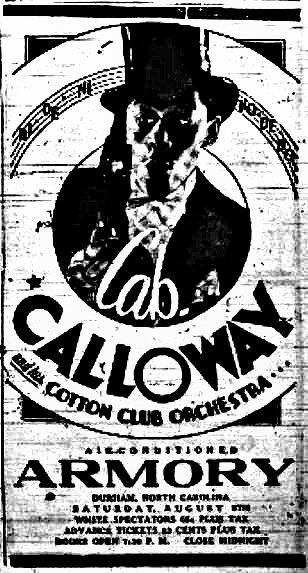
Cab Calloway was a frequent performer not only in Durham, but in other places in North Carolina during the swing era. Calloway’s autobiography says Irving Mills and a “Mrs. Knowles” put together his first southern tour in 1931. “In Durham, NC, we played in a tobacco warehouse that was as big as Madison Square Garden, and they put a rope down the middle of the warehouse and the whites danced on one side and the Negroes on the other.” Calloway’s biography goes on to mention other Durham performances, including a March 1933 performance that was “stopped by a riot.” On August 6, 1938, he made a stop at the newly opened Durham Armory, with the Carolina Times ad touting the Armory’s air conditioning and noting that admission for “white spectators” was $0.65 (sidebar to explain: dances and venues in Durham were segregated and there were promoters who would set up performances at the Durham Armory where Black attendees would pay for general admission – i.e. for dancing on the ground floor – and whites would pay to sit in the balcony and watch). He returned to Durham on March 25, 1940 for a performance at City Auditorium (now The Carolina Theater – 309 W. Morgan St.) for a performance the Monday after Easter. He also notes in his biography that the band needed a white bus driver to get them hamburgers somewhere between Raleigh and Durham on Easter morning. Calloway’s last swing era performance in Durham (that I can find) appears to have been on October 6, 1945 at the Durham Armory.
On November 26, 1937, Andy Kirk and his Clouds of Joy performed at the Durham Armory (heated), but check out whose loveliness graces the ad, even if she’s not given top billing? As mentioned before, Mary Lou Williams would return to Durham on a more permanent basis in the 1970’s and this ad illustrates that she, even in 1937, was a respected jazz woman and a draw to audiences. Dancing from 9:30 p.m to 1:30 a.m. – basically my perfect evening dance time frame! Andy Kirk and his Clouds of Joy would return to the Durham Armory on February 26, 1943 and on June 23, 1943 to perform, boths times featuring June Richmond on vocals.
In March of 1938, Lucky Millinder‘s orchestra made an appearance at the Durham Armory – unfortunately, the only report available is through the lens of a white Duke student, The Duke Chronicle’s music columnist Hal Rees: “Did you notice that fine trombone soloist and section of Lucky Millinder’s at the Armory? Far above the average for a Negro band as was the alto sax who gave out quite a few boots on his horn…” (you’ll see earlier in the column where he has received complaints about said column, I’d say deservedly so). Millinder would return at least twice more time to perform at the Durham Armory on December 25, 1942 and on June 14, 1943 (which I’ll come back to below).
A 1939 ad from The Carolina Times, courtesy of Ken Hanson
On May 9, 1938, the Count Basie Orchestra – “America’s Newest Swing Sensation” – featuring Helen Humes and Jimmy Rushing appeared at the Durham Armory, which was their last stop before heading to New York for a week-long residency at the Apollo Theater. Basie would return to the Durham Armory again on April 28, 1939, as shown in the The Carolina Times ad pictured here (thanks to local dancer Ken Hanson for digging through this newspaper source material and adjusting the resolution on these already fuzzy resolution ads). In some cases, we’ve resorted to looking at ads on buildings in photographs, such as this instances on the Open Durham blog – a photo of The Regal Theater taken in 1946 (324-328 E. Pettigrew St.) (though on the Regal Theater’s blog entry, the photo is a date range of late 30’s-early 40’s), we can see posters for Count Basie pasted to the side of this building, which I hope we can presume that Basie was actually performing at this venue – the Open Durham blog notes that Basie was among other luminaries performing at this venue, though it was predominantly a movie theater by the 1930’s.
The Regal Theater at night, 1947 – photograph from Open Durham. The Regal Theater was owned by George and Maude Logan and was part of Hayti, Durham’s African-American community/district.
A 1943 ad from The Carolina Times, courtesy of Ken Hanson
Incidentally, internet searches for Count Basie and Durham, NC are a bit stymied by Basie sideman, composer, and arranger Eddie Durham, but then I find that Eddie Durham came to play at the Durham Armory on July 1, 1943 with “his All-Star Girls Band” (also known as Eddie Durham’s All-Star Girls Orchestra). Due to the proximity of Camp Butner, established in 1942 as a result of World War II, and promoters such as Lin Holloway and Lathrop Warren Alston (more on him below) advertising to draw Black servicemen to shows in Durham, the service-focused All-Stars were a perfect fit for this time and place. The All-Stars “dedicated at least one night per week on the war effort and their activities included raising war bonds, uplifting morale, and performing at military camps and USO centers.”
Carolina Times ad, courtesy of Ken Hanson
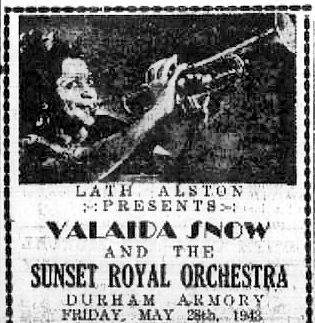
Speaking of all-girl bands of the 1940’s, the International Sweethearts of Rhythm graced the Durham Armory stage on June 4, 1943 just a few weeks before the All-Stars came into town – I can’t tell you how excited I am to know this, I only wish I could find more details! Just a few days before the Sweethearts were in town, Valaida Snow and the Sunset Royal Orchestra performed at the Durham Armory on May 28, 1943 – yes, ladies!
Backtracking a bit, on May 15, 1940, Glenn Miller‘s orchestra performed at Duke University’s Cameron Indoor Stadium (115 Whitford Dr., built in 1939) and broadcast the performance live as part of the CBS Chesterfield “Moonlight Serenade” program. I can’t imagine Cameron Indoor Stadium being a great acoustic space for a broadcast, but I can imagine that this was selected as the venue (over one of Duke’s ballroom spaces) due to its capacity – an estimated 12,000 people were in attendance. To give you perspective on the attendance, the seating capacity of Cameron today is 9,314, so imagine every seat full and the dance floor (i.e. the basketball court) packed! Of course this may have been an over-estimation, but the point is made. As a souvenir, we have an air check of the band playing St. Louis Blues. However, it was another recording that made me realize that Miller had performed at Duke – as I was going through uptempo tunes for competition music ideas, I came across a live recording of Miller’s orchestra playing Down South Camp Meeting, where the announcer at the beginning mentions Duke University and apologizes for something – I have no idea what the apology is for, but I’m definitely curious as to what happened!
Duke University commencement in Cameron Indoor Stadium, 1940 – perhaps just days/weeks from the Miller concert? Photograph from Open Durham.
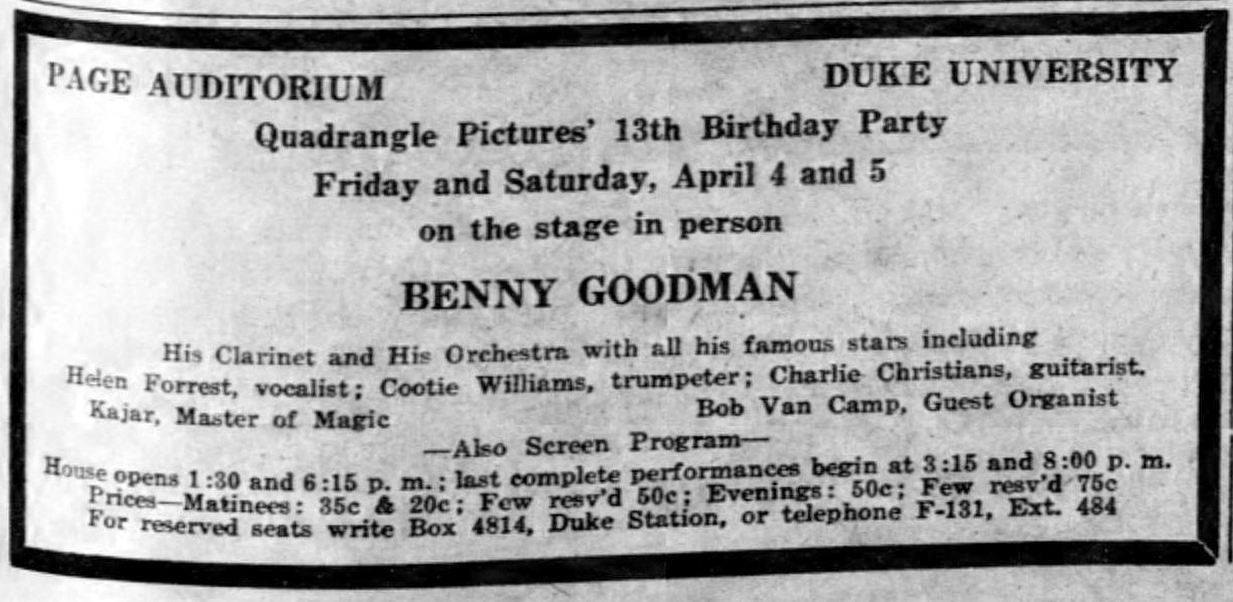
On April 4 and 5, 1941, the Benny Goodman Orchestra, featuring Helen Forrest, Cootie Williams, and Charlie Christian, performed at Duke University’s Page Auditorium (402 Chapel Drive), but also appears to have played a dance or two somewhere on campus during this time frame, as well. The ad from The Carolina Times (courtesy of Ken Hanson) only references shows at Page Auditorium, with two matinees at 3:15 p.m. and evening shows at 8:00 p.m., featuring Bob Van Camp on organ (perhaps a Duke University senior at this time?) and “Kajar, Master of Magic” (maybe this guy?). The Page Auditorium shows were sponsored by Quadrangle Pictures, which formed in 1928 to screen motion pictures on Duke’s campus and was celebrating its 13th birthday party with this concert series. However, we also know from The Duke Chronicle that the Pan-Hellenic council was hosting their second dance of the year during this stop in Durham with the Goodman orchestra – if Goodman’s in town, it’s gotta be dance or bust, who wants to sit in an auditorium listening to this toe-tapping music when there are rugs to be cut? There’s also a photo of Goodman at this dance in the university archives (included below), perhaps snapped by a student or amateur photographer, which is clearly a dance (streamers, people standing around in tuxes/formalwear in front, and people facing each other dancing in the background). Perhaps the best thing about this photograph is Benny Goodman’s expression – did the photographer catch him off-guard or is the photographer the recipient of “The Ray,” Goodman’s infamous withering gaze?
CarolinaTimes ad from Ken Hanson
Another aside, my Duke University searches keep getting stymied by Duke Ellington…but I digress, there are worse things… 😉
The Ink Spots were frequent performers at the Durham Armory in the 1940’s – swing dancers today don’t often dance to their music, but they were super stars, with a #1 hit with their recording of “If I Didn’t Care” in 1939, which remains one of the best selling singles of all time (9th, according to Wikipedia at the time of this post). Fresh off their hit single, the Ink Spots first performed at the Durham Armory on March 8, 1940 and returned on June 20, 1941.
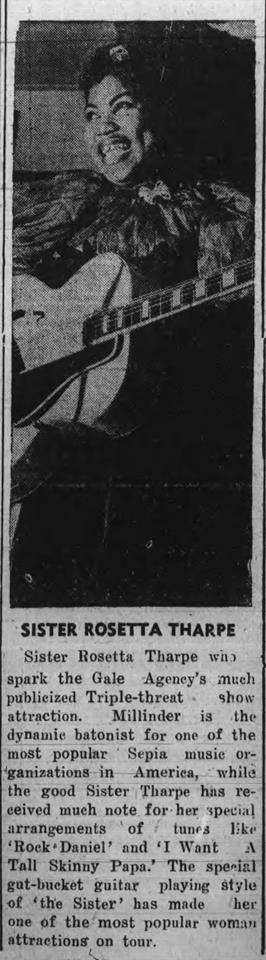
On June 14, 1943, the Ink Spots were slated to play a double bill with Lucky Millinder, featuring Sister Rosetta Tharp, at the Durham Armory. All the musicians were staying at the Biltmore Hotel (330-332 E. Pettigrew St., one of the preeminent hotels catering to African-Americans in the southeast during the swing era, so the likely place for traveling big name bands and musicians to stay) and it was here that things started to go horribly wrong for Lucky Millinder before the show even started.
The Carolina Times headlines, courtesy of Kirk Eisenbeis
Ad from The Carolina Times, courtesy of Kirk Eisenbeis
From The Carolina Times, dated June 19, 1943: “Orchestra Head Gets Cut in Argument Over Room, by Joseph Hopson. In a fracas staged in front of the entrance of the Biltmore Hotel, Lucky Millinder was seriously stabbed in the right hip by a woman companion of one of the Four Inkspots here Monday afternoon. The brawl is said to have arisen by Millinder arguing with the woman over his having rented the best rooms in the hotel for his bandsmen. The woman hailed a passing taxi-cab and went to the uptown section of Durham where she purchased a knife and returned and proceeded to cut Millinder without warning. By-standers finally succeeded in wresting the knife from her hands, but not before she had seriously cut Millinder in the right leg, severing an artery. Millinder was unable to appear with his band in the Durham engagement. The Inkspots left the show crew in Durham after the engagement at the Armory, but appeared with them in Raleigh on the following night. According to bandsmen, Millinder is doing “fair” at present.”
I have so many questions about this incident that will never get answered. We know Millinder made a recovery and remained active in music until the 1950’s, so that’s good, but who is this mysterious companion of the Inkspots? What the heck did Millinder say to her? Were the hotel rooms really worth it or was this about something else? Did Millinder’s band do the show without him? If so, can you imagine the tension on stage? Just…wow.
From May 3 through June 29, 1944, the Ink Spots went on tour with Ella Fitzgerald and Cootie Williams and his Orchestra, stopping at the Durham Armory on June 8. Sharing the bill with them at the Armory were Moke & Poke (some sort of act from New York?), Eddie Vinson, and Ralph Brown (maybe the tap dancer?) – this must have been a big show!
The last performance for the Ink Spots at the Durham Armory that I can find is February 1, 1947, appearing with Johnny Otis and his Orchestra.
On April 6, 1942, Claude Hopkins and his Orchestra performed on Easter Monday (was this a local tradition? See above, Cab Calloway performed on Easter Monday in 1940) at the Durham Armory, featuring Belle Powell. It looks like the promoter for this concert was the Auspices Junior Auxiliary of Lincoln Hospital, which means this show may have been a fundraiser or benefitted the hospital in some other way. Founded in 1901, Lincoln Hospital was the first hospital in Durham to provide care to African-Americans and a nursing school was established there in 1905. The Junior Auxiliary, at least in 1938, was focused on the children’s ward of the hospital, purchasing equipment and supplies, acting as hostesses at events, and decorating and providing children at the hospital presents at Christmas.
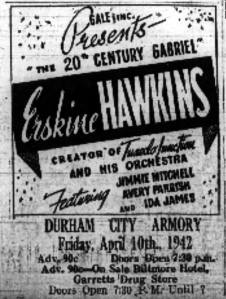
The Carolina Times ad, courtesy of Ken Hanson
Erskine Hawkins, “creator of Tuxedo Junction” / “the 20th Century Gabriel” and his Orchestra performed at the Durham Armory on April 10, 1942, along with Jimmie Mitchell, Avery Parrish, and vocalist Ida James. Note at the top of The Carolina Times ad to the left the “Gale Inc. Presents,” designating that this is a Moe Gale talent booking – this is not the only Moe Gale reference I’ve seen in my research, so it appears there is a direct link between this co-founder of the Savoy Ballroom (and the bands performing there) and the shows and bands being booked at the Durham Armory. Also, note that the time is listed as “7:30 P.M. – until?” I wonder if they also stayed up dancing until 4:00 a.m. like today’s swing dancers…
Hawkins would return to the Durham Armory for another show on April 16, 1943 and made a radio appearance on WDNC prior to the show. WDNC was Durham’s first radio station, going on the air in 1934. At the time of Hawkins’ appearance, he would have only had to go around the corner from the Armory to 138 E. Chapel Hill Street to get to the radio station.
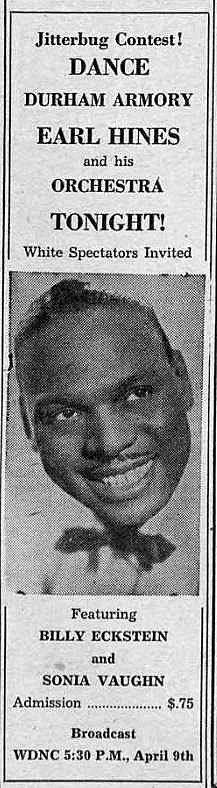
Just a few days later on April 19, 1943, Earl Hines and his Orchestra featuring Billy Eckstine and Sonia Vaughn would appear at the Durham Armory, also with a radio appearance on WDNC prior to the show. There was no Sonia, this was a terrible typo – it was actually Sarah Vaughan, who had been “discovered” in the fall of 1942 at the Apollo Theater’s famous amateur night and had just replaced Earl Hines’ previous female vocalist on April 4, 1943. Vaughan was initially hired as a pianist for the band (though she also sang) so that she could be under the jurisdiction of the musicians union rather than the singers union, so the Armory crowd may have heard Vaughan on piano and vocals. The Carolina Times ad for this performance leads with “Jitterbug Contest!” – this is the only reference to a swing dance contest I’ve come across in these Carolina Times ads and I, of course, would love to know the format, what song was/songs were played for the contest, the tempos, all these things lost to time that I will never glean from these two magic words in a newspaper ad. One thing we do know is that this show would have been awesome and a dance contest with live music by Earl Hines’ Orchestra would have been a dream!
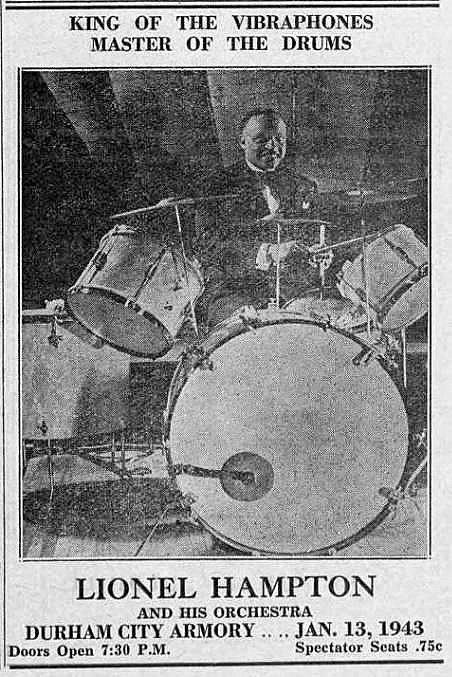
One of my favorite bandleaders, Jimmie Lunceford, and his orchestra performed at the Durham Armory on November 27, 1942 and again just a few months later on March 11, 1943. On January 13, 1942, “King of the Vibraphones Master of the Drums” Lionel Hampton performed at the Durham Armory. On November 19, 1943, Oran “Hot Lips” Page performed in Durham at an unknown venue. On December 27, 1943, Buddy Johnson made an appearance at the Durham Armory, presented by Latha Alston. I also found a source that says Louis Jordanperformed at the Durham Armory in the 1940’s, but doesn’t provide a date. Sadly, I can’t find any other information about these performances in Durham, but it looks like the early 1940’s were great years for live music in Durham!
Royal Knights of King David Hall in 1922, from Open Durham
One of the most prolific promoters I’ve seen in these source materials is Lathrop Warren Alston (also seen in sources as Latha, Lath, and Lathe, as well as with the last name Austin, however this is probably a typo since Alston is an old Durham family name). Alston got his start promoting dances in the 1920’s at the Royal Knights of King DavidHall (702-704 Fayetteville St.). It is clear that Alston was great at this work, moving on to larger venues and big name acts, having a hand in some of the tobacco warehouse concerts (given the Royal Knights’ connection to NC Mutual Life Insurance, I’m curious to know if he promoted that famous “In a Sentimental Mood” concert). His success is apparent in the sheer number of concerts where his name is associated, particularly at the Durham Armory, given the limited resources I’ve been able to locate online – he is credited here (and elsewhere) for concerts with Cab Calloway, Duke Ellington, Earl Hines, Guy Lombardo, Fats Domino, and Les Brown. Alston went on to become the manager of the Biltmore Hotel (330-332 E. Pettigrew St.), where he continued to feature live music, such as concerts with Ella Fitzgerald, Nat “King” Cole, and the Ink Spots. I see that William A. Marsh, III (who I know as Judge Marsh, former Durham County District Court Judge) is credited as the source material on Alston, so I’ll have to ask him about it at some future Durham Bar function.
The Biltmore Hotel and Regal Theater in 1946, with the Count Basie posters pasted on the wall to the right, photograph from Open Durham.
Photograph from Open Durham
DIXIELAND REVIVAL
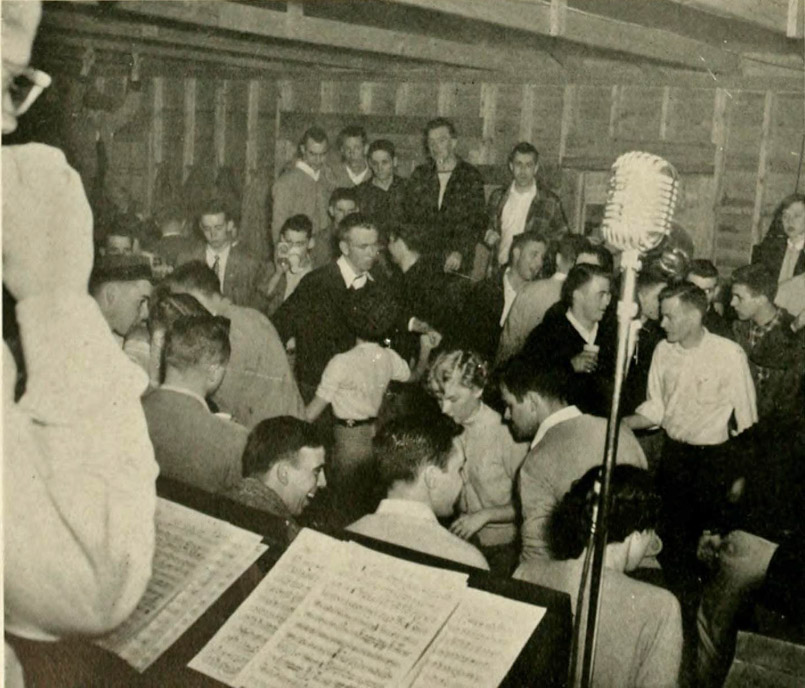
I wasn’t going to go past WWII, but I couldn’t resist posting about Turnage’s BBQ Restaurant (608 Morrene Road), where after WWII you could catch “Jazz at Turnage’s” – trad jazz/Dixieland jam sessions, performances, and dancing, in addition to some classic North Carolina BBQ. The photograph below (the real reason I’m posting about this – dance evidence!) is from 1952, quoting Open Durham: “It was evidently popular with Duke students as well – the picture is from the Duke Chanticleer, captioned “JAM SESSIONS, featuring Dixieland Jazz Combo and some fast jitterbugging, shook the rafters on Saturday afternoons of spring semester.”
Durham jitterbugs in 1951 – photograph from Open Durham
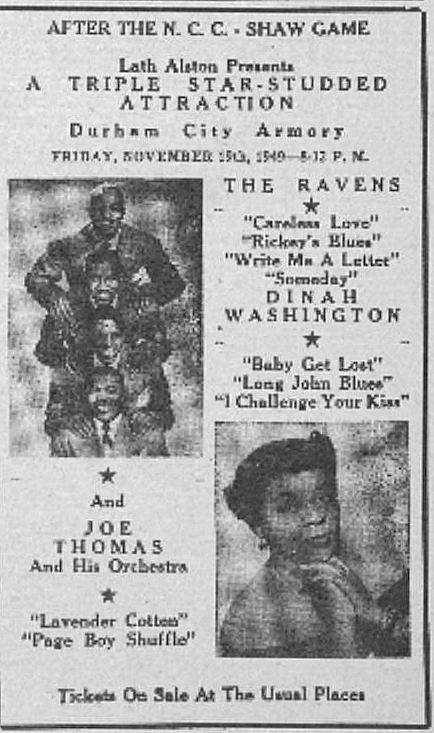
I am certain there is much more information about swing bands, dancing, and related local culture that I have not found in my online searches, but I feel like this is a solid start. Perhaps the most glaring omission are Durham-based hot jazz and swing bands (that perhaps did not reach the level of fame as those touring bands herein) outside of those formed by students at Duke University – if you have any leads or other sources of information, please feel free to leave them in the comments below! I’ll leave you with an ad relevant to my recent musical performance interests (but after the time frame of this post) and some more ads I couldn’t fit into the text of this post (all courtesy of Ken Hanson).
Addendum 5/25/19: You can listen to about 15 minutes of the May 15, 1940 Glenn Miller broadcast from Duke University at the Star Spangled Radio Hour podcast’s 4/14/18 episode, starting around time stamp 1:22:25. Thanks to Ken Hanson for the additional link!
Addendum 7/21/23: Tom Lassiter, father of Mint Julep Jazz Band guitarist Ben Lassiter, reached out to me recently (after I shared this post in anticipation of Flying Home 2023) to share the following: “Ben never met his great-uncle, Walt Lassiter. My Uncle Walt died a couple of years befoe Ben was born. Both he and my father learned to play trumpet while in school bands in Smithfield, NC. Their first cousin, Tom, played trombone. By the early 1930s, Walt and Tom were at Duke and still playing their horns. I have vivid memories of Walt talking about playing with “Jelly Leftwich and his orchestra,” especially summer gigs at the Lumina at Wrightsville Beach. Your recent mention of Durham’s musical heritage reminded me of all that. Here’s a page from Duke’s yearbook, The Chanticleer, 1932 edition. In the photo, Tom is holding his trombone. Walt is beside him, standing third from right.
In 1934, Ella Fitzgerald was a homeless teenager on the streets of Harlem with an incredible voice – she was discovered at the Apollo Theater’s famous amateur night that year and was quickly picked up by drumming powerhouse Chick Webb to perform in his orchestra. Chick Webb’s band was the most prominent of the house bands at the Savoy Ballroom, one of New York’s largest ballrooms, the only integrated ballroom in New York, and the birthplace of Lindy Hop. Before she was the First Lady of Song, Ella honed her skills as a big band singer with some of New York’s top working jazz musicians of the 1930’s.
April 25, 2017 marks Ella’s 100th birthday and, as a centennial tribute, a group of Triangle musicians has come together to celebrate her early work with the Chick Webb Orchestra and, in the years following Chick Webb’s death in 1939 at the height of the orchestra’s fame, leading the orchestra under her own name – Ella Fitzgerald and her Famous Orchestra.
Come see the show on April 23, 2017 from 7 p.m. to 9 p.m. at Sharp Nine Gallery/Durham Jazz Workshop, 4608 Industry Lane, Suite L, Durham, NC – tickets are $20.00 and you can purchase them through Brown Paper Tickets. For more information, visit the Sharp Nine Gallery website.
Laura Windley – vocals
Kobie Watkins – drums
Jim Crew – piano
Peter Kimosh – bass
Chip Newton – guitar
Keenan McKenzie – reeds
Aaron Hill – reeds
Dan Hitchcock – reeds
Taylor Savage – reeds
Lucian Cobb – trombone
Evan Ringel – trombone
Jim Ketch – trumpet
Kyle Santos – trumpet
Paul Rogers – trumpet
Here it is, 3 sets (and two encores!) of Chick Webb music in all its glory at Lindy Focus 2016! As with any tribute, we hope that the band was able to capture the magic of a night at the Savoy Ballroom, with the most famous of the Savoy’s house bands. Much love to everyone who contributed to the transcription project to make this dream a reality!

















 Laura Windley – vocals
 Laura Windley