Cab Calloway

Erskine Hawkins Orchestra – Vocalists

Ella Fitzgerald, Dinah Washington, Helen Humes, Billie Holiday, Ivie Anderson, Helen Ward, Helen Forrest – these are some of the iconic big band vocalist names whose works have inspired performances at Lindy Focus and, for Fitzgerald and Washington, featured charts in the Heritage Sounds transcription projects. As we approach the year of Erskine Hawkins as the featured bandleader for the 2024 transcription project, you may notice that there’s not a definitive vocalist in his lineup, except perhaps Hawk himself yelling out “Tuxedo!” as his band launches into that famous tune. His discography hints at 11 featured vocalists and there were others as the band continued live performances into the 1960s. The in-depth biographies of most these musicians may be largely lost to time, but here’s a bit of information – dates denote recording release years and/or other dates I may have found online:

JIMMY MITCHELL, alto saxophone and vocals (1936-1949 recordings, ‘Bama State Collegians and E.H. Orchestra)

“Hawk, if you can keep us working, we will stay with you.” This was the sentiment that the rest of the ‘Bama State Collegians as the band embarked on their tour to New York in 1934. Jimmy Mitchell was one of those musicians, a reed player and the most consistent and prolific vocalist of the Erskine Hawkins Orchestra. Mitchell goes all the way back to Birmingham Industrial High School and, as a student of the esteemed “Fess” Whatley, was granted a music scholarship to Alabama State Teachers College along with others of his Industrial HS peers, including Erskine Hawkins. There is scant biographical information about Mitchell online, but one thread throughout is that mentions of Mitchell in the press and in references online show that he was a featured vocalist, a named musician in advertisements, and thus a draw to the orchestra for his popular vocal stylings.

Mitchell recorded 39+ vocal sides with the Orchestra, in addition to being featured on radio broadcasts, for which we still have recordings. The ‘Bama State Collegians were signed to Vocation and Mitchell recorded the first song of their first New York recording session, “It Was a Sad Night in Harlem” (an ironic choice, as I’m certain their residency at the Savoy inspired many happy nights) on July 20, 1936. For the transcription project, we’ve picked his rendition of Keep Cool, Fool from 1941. His last recording with the Orchestra was “Brown Baby Blues” on November 30, 1949.

WILLIAM “BILLY” BOONE DANIELS (1935-1936)

Billy Daniels is one of most famous people on this list and has a Hollywood walk of fame star to prove it. Born in Jacksonville, Florida, Daniels moved to Harlem in 1935 with the intention of attending law school at Columbia. He worked at Dickie Welles’ Place as a busboy, then as a singing waiter. It was here that Daniels was plucked from obscurity by Hawkins and invited to join his orchestra. He toured with the Hawkins orchestra throughout 1936 and recorded three sides with the band. He left the band to pursue his solo act, with performances at the Onyx Club, Ebony Club and the Famous Door.

This was just the beginning – Daniels went on to radio, records, Broadway productions, Las Vegas residencies, made three films for Columbia Pictures, and hosted his own television show starting in 1952. The Billy Daniels Show was the first sponsored television show starring a black entertainer. The show was broadcast from the same theater that would later be named the Ed Sullivan Theater, now home to The Late Show with Stephen Colbert.

His most famous tune was “That Old Black Magic,” recorded in 1948, after his service in the Merchant Marines during WWII ended, and sold more than nine million copies. Compare to his first recording ever (which was during the first Hawkins orchestra recording session in 1936), the classic “Until the Real Thing Comes Along.”

MERLE TURNER (recordings from 1936-1938, ‘Bama State Collegians and E.H. Orchestra)

Merle Turner from Charleston, West Virginia joined New Orleans-born, Texas-based territory bandleader Don Albert as a vocalist in 1935. The band recorded 8 sides at a recording session in San Antonio, Texas in November of 1936, including a Turner vocal on “Sheik of Araby” (with the “with no pants on” call/response).

In June of 1937, Albert’s orchestra arrived in New York, but had difficulty finding work in a saturated market. They played at least one show in New York, because Leonard Feather wrote in Melody Maker about the band’s recording of Sheik, which had “caused a considerable mystery” since they were an unknown band.

Turner (perhaps seeing the writing on the wall, needing work, and/or using the review of his vocal recording as a springboard) left the Albert band that same month to join the ‘Bama State Collegians. Wasting no time, Turner went into the studio with the Collegians on August 12, 1937, singing “I’ll Get Along Somehow,” with the croon of an Ink Spot and a high note to finish. Turner recorded several more sides with the Orchestra through September of 1938.

Beyond 1938, I was only able to locate a recording Turner made in 1946 with Hawkins alum/trumpeter Wilbur “Dud” Bascomb leading the session, the aptly titled “Just One More Chance.”

RUBY HILL (1937)

While Hill is credited as being a regular vocalist with the Hawkins Orchestra in 1937, her web presence is primarily limited to her performances at the Harlem Uproar House and the Apollo Theater.

On January 29 1937, Hill appeared at the Apollo along with Willie Bryant and comedian Pigmeat (presumably Markham? A Durham, NC native!).

In the April 1937 issue of The Show-Down, a magazine documenting night clubs, theaters, and performers, gave Ruby Hill a shoutout – “Ruby Hill’s torch songs touch one from head to toe” – in a rundown of accolades from a revue at the Harlem Uproar House. The revue featured Hawkins’ Orchestra and a cast that included vocalist Velma Middleton, Savoy Ballroom emcee Bardu Ali, and Tiny Bunch leading a troupe of Lindy Hoppers.

On November 3, 1939, Hill was back at the Apollo Theater with Noble Sissle.

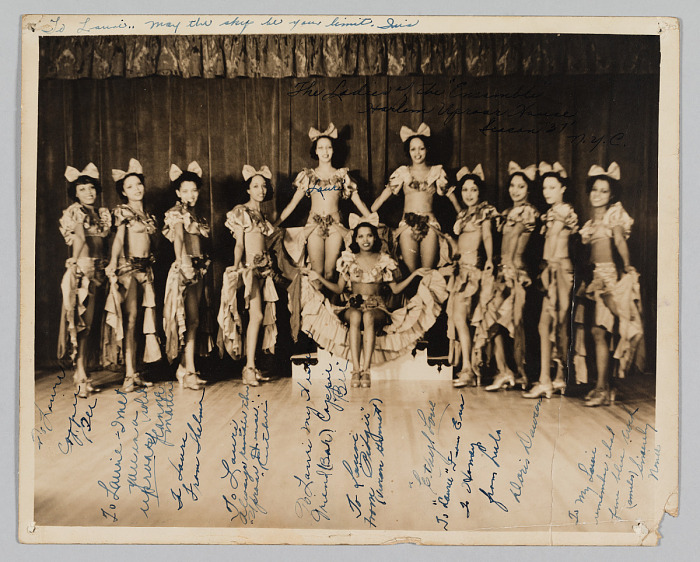
I was not able to locate a photograph of Hill, so I leave you with a photograph of the chorus line at the Harlem Uproar House from 1937.
IDA JAMES (recordings 1938-1939)

A native of Providence, Rhode Island, Ida was still young when she started her career in Philadelphia, performing on The Horn and Hardart Children’s Hour on WCAU in the 1930s. By January 1937, she was singing with Earl Hines’s Orchestra in Chicago and stayed with him until May 1938, when she joined the Erskine Hawkins Orchestra. She stayed with the Orchestra on and off until 1942, which was basically a launch pad for her, because she stayed busy in the 1940s!

  • 1944
  • 1945
    • Appeared in Olsen and Johnson’s (the creators of Hellzapoppin’) Laffing Room Only revue
    • Appeared in the all-black musical Memphis Bound
    • Recorded two sides with the Ellis Larkins Trio
    • Ended the year with her own USO unit and went to the South Pacific
  • 1946
    • Toured the theater and nightclub circuit in the US
  • 1947
    • Began a residency at the Savannah Club in New York that lasted over 6 months
    • Starred in the film Hi De Ho as Cab Calloway’s manager
    • Signed with the Manor label, but only recorded 4 sides before the recording ban of 1948
  • 1949
    • Appeared on the TV show Adventures in Jazz

James continued recording and performing in theater until the mid-1950s. For the transcription project, James gives us three vocal tunes: Knock Me a Kiss, I the Living I, and Jumpin’ in a Julep Joint.

DOLORES BROWN (recordings 1939-1940, 1945)
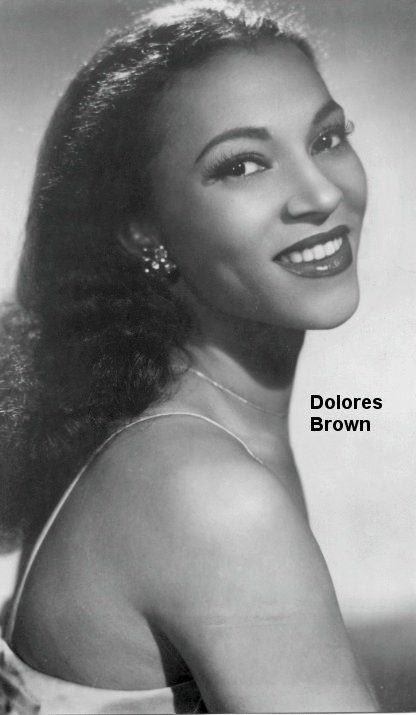
Brooklyn native Dolores Brown was born to musical parents – Edna Hiddleston, a pianist, and Bill Brown, trombonist and leader of Bill Brown and his Brownies, who had a radio broadcast and cut a few sides for Brunswick in the late 1920s. Brown cut her teeth performing at school and community functions as a tween and transitioned to professional work in her late teens.

In 1938, Brown had a residency at the Black Cat in Greenwich Village as part of the club’s revue. She performed at the Apollo Theater’s Amateur Night and, like the Cinderella story of Ella Fitzgerald, was scouted and joined Duke Ellington’s Orchestra in the summer of 1938. She toured with Ellington until January, 1939, then left the Orchestra for reasons unknown. She joined a revue at the Kit Kat Club for spring of 1939.

On August 17, 1939, the California Eagle reported that Brown had joined the Erskine Hawkins Orchestra. Brown was featured in several recording sessions in 1939 and 1940, starting with the recording Rehearsal in Love. She was also featured at times with the Savoy Sultans during the Hawkins Orchestra’s Savoy Ballroom residency.

Unfortunately, Brown’s early newspaper mentions focus on her relationship with cornet player Leslie “Bub” “Bubber” Lewis, who she started dating in 1936, so we don’t get a lot of context about what she was doing at the time. In 1940, Brown ditched Lewis and fell in love with (and ultimately married) one of the Orchestra’s trumpet players, Marcellus Green. Following their marriage on December 2, 1940, Brown left the band and Hawkins re-signed Ida James as the Orchestra’s female vocalist. Just before she left, Brown recorded the apropos S’posin’ on November 20, 1940, one of the songs selected for the transcription project.

In August of 1942, Green and other Orchestra members Avery Parrish, Lee Stanfield, and Heywood Henry were in a terrible automobile accident near Chattanooga, Tennessee that killed Green and injured the others. I can’t even imagine how significantly this impacted such a closely-knit group, not to mention the accident occurring less than two years into Brown’s marriage to Green.

Brown was all over the jazz-sphere in 1943, at nightclubs and theaters in Pittsburgh, Allentown, Boston, Montreal, Chicago, Detroit, and back to New York. Brown joined Don Redmon’s Orchestra from January through August of 1944, then appeared at the Onyx Club until November of that year. She did a brief stint with Lucky Millinder in 1945, then went back to the Hawkins Orchestra!

The August 4, 1945 issue of Afro-American commented on “her courageous return to show business. Dolores thought that she was through with singing, but fate played a different hand.” She stayed with the Orchestra until April of 1946, then left again for reasons unknown. She continued recording and touring throughout the US with jazz luminaries through the 1960s. Brown never remarried and news of her passing in 2003 named her as “Dolores Green.”

EFFIE SMITH (1944 Jubilee Broadcasts)

From an Amazon.com record description: “Part of the explosion of black entertainment that occured on the West Coast in the early 1940’s, which led to an eruption of independent record labels and the birth of the R&B record industry, California was the breeding ground for the recording careers for a host of strong, talented women performers – among them was Effie Smith, a talented singer and comedienne whose career stretched from the early 1930’s until the early 1970’s. Early on Effie worked in Lionel Hampton, Erskine Hawkins and Benny Carter’s orchestras, and later on with small bands organized by Johnny Otis and her husband, John Criner, as well as R&B legends Roy Milton and Buddy Harper. With the advent of rock n’ roll in the mid-fifties, Effie made several records with The Squires for the Los Angeles based Vita Records imprint.”

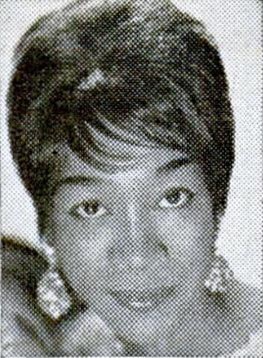
Smith was marketed as Hawkins’ featuring vocalist, as you can see from this head shot, noting Gale Agency as her manager. The only two recordings we have of Smith with the Hawkins Orchestra are those from the October 1944 Jubilee Broadcasts, which were only available on CD until I uploaded Straighten Up and Fly Right to YouTube contemporaneously with the writing of this blog post. Enjoy this recording now and the arrangement live at Lindy Focus once we’ve completed the transcription project.

ASA “ACE” HARRIS, piano and vocals (recordings 1944-1950)

Harris grew up in Florida playing piano and in 1930 (when he was 20) he joined Billy Steward’s Celery City Serenaders (Celery City = Sanford, FL), a territory band that toured throughout most of the US. In 1935, he joined the Sunset Royal Serenaders. Within months of joining the SRS, their frontman Steve Washington died of pneumonia in January of 1936. The trombonist Doc Wheeler took over leading the band and, during a double bill with the Tommy Dorsey Orchestra in Philadelphia, Dorsey snaked the band’s 4/4 version of Marie with band vocals (originally an Irving Berlin waltz) and it became a hit for Dorsey in 1937. After proving himself as an excellent showman, Harris took over leadership of the band and they recorded in 1937 as Ace Harris & his Sunset Royal Orchestra.

When the band made it to New York City in 1939, Harris decided he wanted to stay. From 1940-1942, Harris was an accompanist and arranger for The Ink Spots. The Ink Spots often toured with the Erskine Hawkins Orchestra, so it was easy for Harris to transition to performing with the Orchestra full-time in 1944. The Orchestra had a hit in 1945 with his recording of “Caldonia” (#13 for the year on R&B charts). He continued to simultaneously perform with the Orchestra and manage his own solo recording career, recording for New York City labels Hub and Sterling between 1945 and 1948. In 1947 he left the Orchestra, but returned from 1950-1951 and recorded the Orchestra’s last R&B hit (#6 on the charts in December 1950) “Tennessee Waltz.” He also returned in 1955 to record a couple of singles for Decca.

Throughout the 1950s Harris continued performing and recording. He had a residency at Chicago’s Black Orchid alternating and performing piano duos with Buddy Charles. The pair had such a following that they recorded an album in 1957.

At some point, Harris’ sister married Hawkins, but it is not clear if that was Hawkins’ first wife Florence Browning, who he married in 1935, or if it was Gloria Dumas, who he married “later,” of whom the internet has almost no information.

Harris’ daughter, whose name is also Asa Harris, is/was a Chicago-based jazz vocalist.

CAROL TUCKER (recordings 1945)

Tucker grew up in Chicago in a musical family, as the child of a bandmaster of the Eighth Illinois Regiment. She attended DuSable High School, where she worked with Walter Dyett, a music educator who also worked with young Nat King Cole, Bo Diddley, Milt Hinton, and Dinah Washington. After graduating in January 1945, she secured an audition and landed a spot with the Erskine Hawkins Orchestra. The Orchestra had a residency at the Regal Theater, then hit the road to cities on the east coast. The press was receptive and, by the time she got to New York with the band, her star had risen.

She recorded two tunes with the Orchestra, “I Hope I Die If I Told You A Lie” on March 28, 1945 and “Prove It By the Things You Do” on April 23, 1945 (the B side to Harris’ “Caldonia”).

At some point while in New York, Tucker became “stricken” with an unidentified ailment. Hawkins’ physician examined Tucker and recommended that she return to Chicago to rest at home. She died of this mystery illness in the first part of March 1946.

RUTH CHRISTIAN (recording 1946)

Christian grew up in New York and showed up in the entertainment press in 1939 as the vocalist for Buddy Walker and His Harlem Varieties. She had radio performances and was billed as such in a star-studded opening performance at the Community Theater Of St. Martin’s in Harlem on October 11, 1940, along with Ethel Waters, Katherine Dunham, Willie Bryant, W.C. Handy, and the Delta Rhythm Boys, among others.

At some point, Christian attended and graduated from college, perhaps in this gap between press clippings in the early 1940s. While in college, Christian met Ethel Harper, Leona Hemingway, and Charles Ford, who began singing as a vocal quartet, sharing performances with college choirs and participating in church services. The quartet began singing professionally around 1942, billing themselves as The Ginger Snaps (but may also be identified as the Four Ginger Snaps, the Gingersnaps, and the Four Gingersnaps because news sources seem to have chronic issue with band names). Their first show of record is as part of “Harlem Cavalcade”, an all-black variety show produced by Ed Sullivan that ran for most of May 1942 at the Ritz Theater. In July 1942 they appeared at Kelly’s Stable, then at the Apollo Theater the second week in November, sharing the stage with the Fletcher Henderson Orchestra and Jackie Mabley (later “Moms” Mabley). After a brief run in Philadelphia, they were back in New York and on the radio in December 1942 and at Le Ruban Bleu in January and February 1943, then back to Philly in April to appear with Sidney Bechet in March and April 1943. They spent the summer of 1943 performing in Wildwood, NJ, then back to Philly, then to Cleveland, St. Louis, Wilkes-Barre, and more.

Before the summer gig in New Jersey, The Ginger Snaps filmed three soundies in New York – “Keep Smiling“, “Wham,” and “When Johnny Comes Marching Home.”

In 1944 they appeared on the G. I. Journal radio show, produced by Armed Forces Radio Service (AFRS), singing what appears to be their signature or perhaps most popular song, “The Shrimp Man.”

On April 21, 1944, the Ginger Snaps were back at the Apollo, this time with the Erskine Hawkins Orchestra, and now we know for sure that their paths crossed. The rest of 1944 was back on the road to (you guessed it) Philadelphia, they appeared in a Royal Crown Cola ad, then performed in Atlantic City, Buffalo, Baltimore, Philly, Pittsburgh, Detroit, Rochester, then to California in 1945! In 1945 they recorded songs for three different entities while in Hollywood – at NBC Studios in Hollywood for the AFRS Jubilee series, for University Records, and RCA.

In early 1946, Christian left The Ginger Snaps to join the Hawkins Orchestra. She recorded one side with the Orchestra on April 24, 1946, “That Wonderful Worrisome Feeling.” Unfortunately, Christian then disappears from online sources. POOF!

COZINE STEWART (recording 1946)

The only mentions of Stewart online is her live performance with the Orchestra, a radio broadcast from the Hotel Lincoln’s Blue Room, New York, May 1, 1946 – the song is Personality and I could only find it on CD or LP. I’d like to think someone with the name Cozine has a wonderful personality.

LAURA WASHINGTON (recordings 1946-1947)

Birmingham-born Washington started singing as a child, performing in small clubs and churches, where she was scouted by Birmingham jazz musician J.L. Lowe. Lowe later recommended Washington to Hawkins and she joined the Erskine Hawkins Orchestra in New York as a teenager in 1946 (apparently beating out hundreds of interested vocalists, per the news caption at right), making her debut at the Strand Theater on Broadway. She recorded a total of 5 songs with the Orchestra, scoring a hit within a few months with the tune “I’ve Got a Right to Cry.” The song reached #2 on the Billboard “race” charts and #17 in the year-end ranking for 1946.

While in New York, Washington got to meet her idol, Ella Fitzgerald (yesssssss!), and became friends with another vocalist who shares her surname and home state, Dinah Washington.

Washington married reed man Julian Dash in 1948. In 1952, she and Dash returned to Birmingham and she focused on raising her children. In the 1980s, after her children were grown and Dash had passed away, Washington began singing again, becoming a regular performer at Grundy’s Music Room.

LUCY LU” ELLIOTT (recording 1951)

During high school, Elliott was a tuba player who, at some point, and transitioned to being a vocalist and tuba player. As a teen, she won the Amateur Night at the Apollo Theater, which got the attention of someone important, because by September of 1949 she was recording with Duke Ellington. She left Ellington’s orchestra in February 1950 and turned back up singing with the Erskine Hawkins Orchestra in 1951. She recorded two songs with the Hawkins Orchestra on December 6, 1951, “Lost Time” and “I Remember My Love.”

Jet Magazine was covering Elliott, noting that she was the only woman tuba player in the musicians union in 1954.

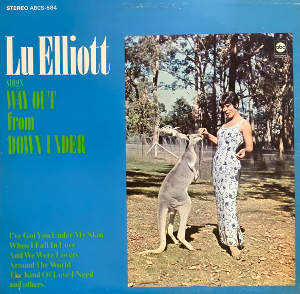
She had a contract and several recording sessions in the 1960s with ABC Paramount. In 1967, she toured with B.B. King, then spend 10 weeks in Australia performing, then recorded an album called Way Out From Down Under, living the dream and feeding a kangaroo on her album cover.
In the 1970s, Elliott continued touring and performing in clubs in New York, New Jersey, The Virgin Islands, St. Thomas, then made her way to Las Vegas to perform with Redd Foxx. She continued performing in New York and Las Vegas almost until she passed away in 1987.

Her sister, Billie Lee, was also a professional vocalist, but I was not able to locate any details online because she shares a name with a reality TV star. Womp womp.

DELLA REESE (1953)

Born Deloreese Patricia Early in Detroit, Reese started singing for her family by imitating movie stars and by the age of 6 had joined her church’s choir. When Reese was 13, Mahalia Jackson was touring with a stop in Detroit and she heard Reese sing in church. She immediately went on tour with Jackson and joined her tour for 5 consecutive summers.

In 1947 she enrolled in Wayne State University as a psychology major and sang in a gospel group called The Meditations. In 1949, at the encouragement of her pastor to pursue more professional singing gigs, Reese took a job at a bowling alley/nightclub as a host and vocalist.

In 1951, Reese was named Detroit’s favorite vocalist in a newspaper poll, which got her a week-long gig at the Flame Show Bar, where the big names in jazz performed. This started a two year period of regular gigs for Reese at the Flame. While at the Flame, she caught the attention of Lee Magid, a New York agent, who convinced her to move to New York in 1953 and found her a placement with the Erskine Hawkins Orchestra.

Unfortunately, her time with the Orchestra was short-lived and she left after less than a year to advance her solo career. Fortunately, this totally worked out for her because her first recordings were hits – “I’ve Got My Love To Keep Me Warm, ” “Time After Time” and “In The Still Of The Night,” sold 500,000 copies. In 1957, her recording of “And That Reminds Me Of You” went gold, selling millions of copies. In 1959, she signed with RCA and had her biggest hit, “Don’t You Know,” which garnered Reese a Grammy nomination.

In the 1960s she had over 300 television appearances, 100 of those just on the Ed Sullivan Show. She was the first woman to substitute-host for Johnny Carson on The Tonight Show. She appeared in night clubs in Las Vegas and all over the U.S. By the end of the decade, however, Reese felt like she needed to pivot to keep working, so she turned to acting.

Reese’s acting debut came in 1968, appearing as a disco owner on The Mod Squad. This, along with the success of her hosting The Tonight Show, led to Reese getting her own talk show in 1969 called simply Della. She was the first black woman to host her own television talk show, which ran for two seasons.

In the early 1970s she picked up touring again, hitting all the hot spot night clubs in the U.S. and toured Europe, Asia, and South America. On Sanford and Son, Redd Foxx starting referring to Reese and Lena Horne on the show as the ultimate black super stars, so of course Reese made a few cameos on the show. She guest starred in other TV shows, did a few pilots, landed a role in the show Chico and the Man in 1976, and finished out the final season of Welcome Back Kotter as a substitute teacher in 1978.

Reese went on in the same can’t-stop-won’t-stop into the 1980s and 1990s – she recorded albums, was nominated for another Grammy in 1987, became an ordained minister, appeared in the film Harlem Nights with Eddie Murphey, starred in a cabaret revue called Some of My Best Friends Are the Blues, she was the literal angel in the TV show Touched by an Angel, was nominated for another Grammy in 1999, added festivals and symphony appearances to her regular performance venues, just crushing everything always. She was the last of the Hawkins vocalists (that I was able to find) to go – she made it to 2017, ending an era.

SOURCES
Erskine Hawkins Orchestra generally 1 2 3 4 5, Billy Daniels 1 2 3 4, Merle Turner 1 2, Ruby Hill 1 2 3, Dolores Brown 1, Ida James 1 2, Effie Smith 1, Ace Harris 1 2 3 4, Carol Tucker 1 2 3, Ruth Christian 1, Laura Washington 1 2 3, Lu Elliott 1, Della Reese 1 2

Early Jazz and Swing in Durham, NC

armory_1950
Photograph from Open Durham of the Durham Armory in 1950 – the site of the Bull City Swingout’s Saturday night main dance and many, many swing era performances.

In anticipation of the Bull City Swingout coming up the second weekend in July, 2019, I sought out information about early jazz and swing in Durham, North Carolina – I found that there was no anthology I could direct people to and the information I could find seemed to be incomplete snippets I had discovered over the years across the internet.  This blog post is an attempt to compile some of this information, with a focus on jazz dance music, and I hope that I can add to this post as I find new information about Durham’s earlier jazz history and about its later jazz history that may be tied to the jazz age and swing era.  Also, here’s a map I’ve compiled with the locations mentioned herein and brief notes on the significance of each pin.

A million thanks to Open Durham for being the consummate historian and source for a lot of this information (either directly or helping to make connections) and many of the Durham photographs.  Thanks also to my fellow RDU swing DJs Sarah Ovenall, Ken Hanson, and Kirk Eisenbeis for your assistance and additions to the spreadsheet that launched this post.

I’m also going to give a content warning for racism – while Durham was a vibrant hub for music and dancing during the swing era, racism and segregation were a prevalent part of the lives of locals and touring musicians.  During my research into this topic I came across multiple sources that reference and/or illustrate the overt racism that existed in Durham during the jazz age and swing era.  Some of this racism is referenced in this post and some of it appears in the linked source material.

hosierymillband
Photograph from Open Durham

RAGTIME ERA/PRE-JAZZ

Because jazz didn’t come to us in a vacuum, I can see evidence that brass band music was present in this tobacco town early on.  We can see that the Durham Hosiery Mill (803 Angier Ave.) had a brass band, take note of the instrumentation, and make some assumptions about the music in 1910.

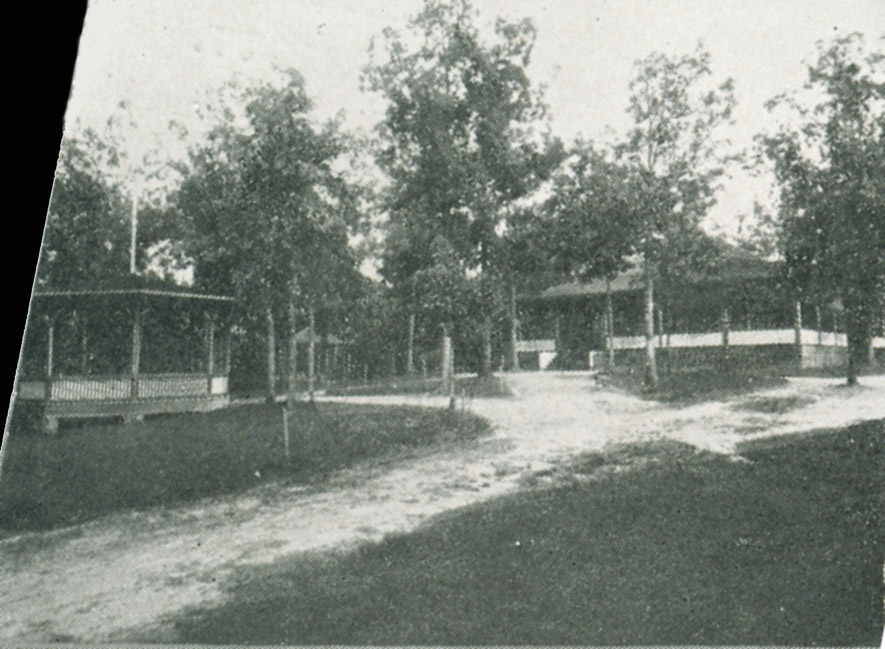
There’s also evidence of dance orchestras in existence and/or playing in Durham during the pre-jazz era.  From 1902 to 1932, Durham was home to the Lakewood Amusement Park (2000 Chapel Hill Road), which held many attractions including a dance pavilion.  From Open Durham: “Across from the skating rink was the pavilion, another large building, which called the Dance Hall by some. The sides were open, and typically an orchestra or band was playing; orchestras came from all over to perform while the crowds danced the night away. Joe King’s orchestra was a popular act. Other people would sit around on benches and just listen to music.”

lakewood_gazebos.jpg
Lakewood Amusement Park’s gazebo (left) and dance pavilion (right) – photograph from Open Durham

PIEDMONT BLUES

200px-Blind_Boy_Fuller
A studio portrait of Blind Boy Fuller, from Wikipedia

I would be remiss if I did not touch on Piedmont Blues as an essential part of the music and dance history of this area, with the style roughly originating in the 1920’s.  Piedmont Blues is usually distinguished from Delta Blues by its ragtime based rhythms.  Durham became an important center of blues culture, with the tobacco industry drawing rural Black people to the city with higher wage jobs and with Durham already established as an African-American business and financial center.  Durham drew Blind Gary Davis in the mid-1920’s and Blind Boy Fuller in 1929 (two of the most famous Piedmont blues musicians, who incidentally made it onto the state historic plaque here in town), who would play house parties and on Pettigrew Street near the tobacco warehouses, along with Alden “Tarheel Slim” Bunn, Richard and William Trice, Floyd Council and other musicians who would contribute to the development of this art form.  By the mid-1930’s the best of these musicians were playing clubs and making records.  Durham had a thriving Piedmont Blues scene throughout the 1930’s until it started to see a decline in the 1940’s.  Piedmont blues remains a tradition in this area and Durham is host to a blues festival, the Hayti Blues and Roots Celebration (formerly the Bull Durham Blues Festival).

Of course dancing is also part of the Piedmont Blues tradition, with a percussive dance people call flat-footing or buck dancing.  The videos I keep coming back to to watch are from 1983, filmed on Algia Mae Hinton‘s porch at her home in Johnston County, which feature Hinton (one of the wonderful bridges to the past who is, unfortunately, no longer with us) dancing, John Dee Holeman (another luminary, who will turn 90 on April 4, 2019) dancing and playing guitar.  There are a bunch of these videos on Hinton’s porch in the Alan Lomax Archive on YouTube.  They are so great, we are lucky to have them as source material.

EARLY JAZZ AND SWING AT DUKE

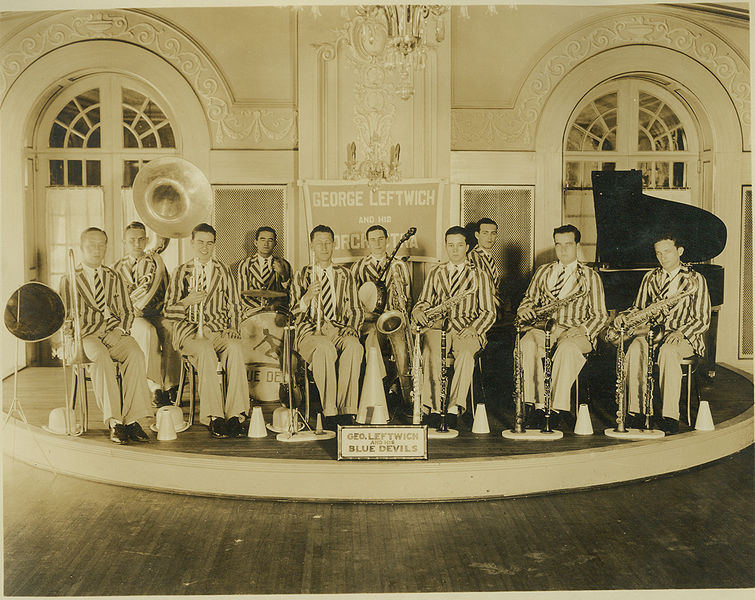
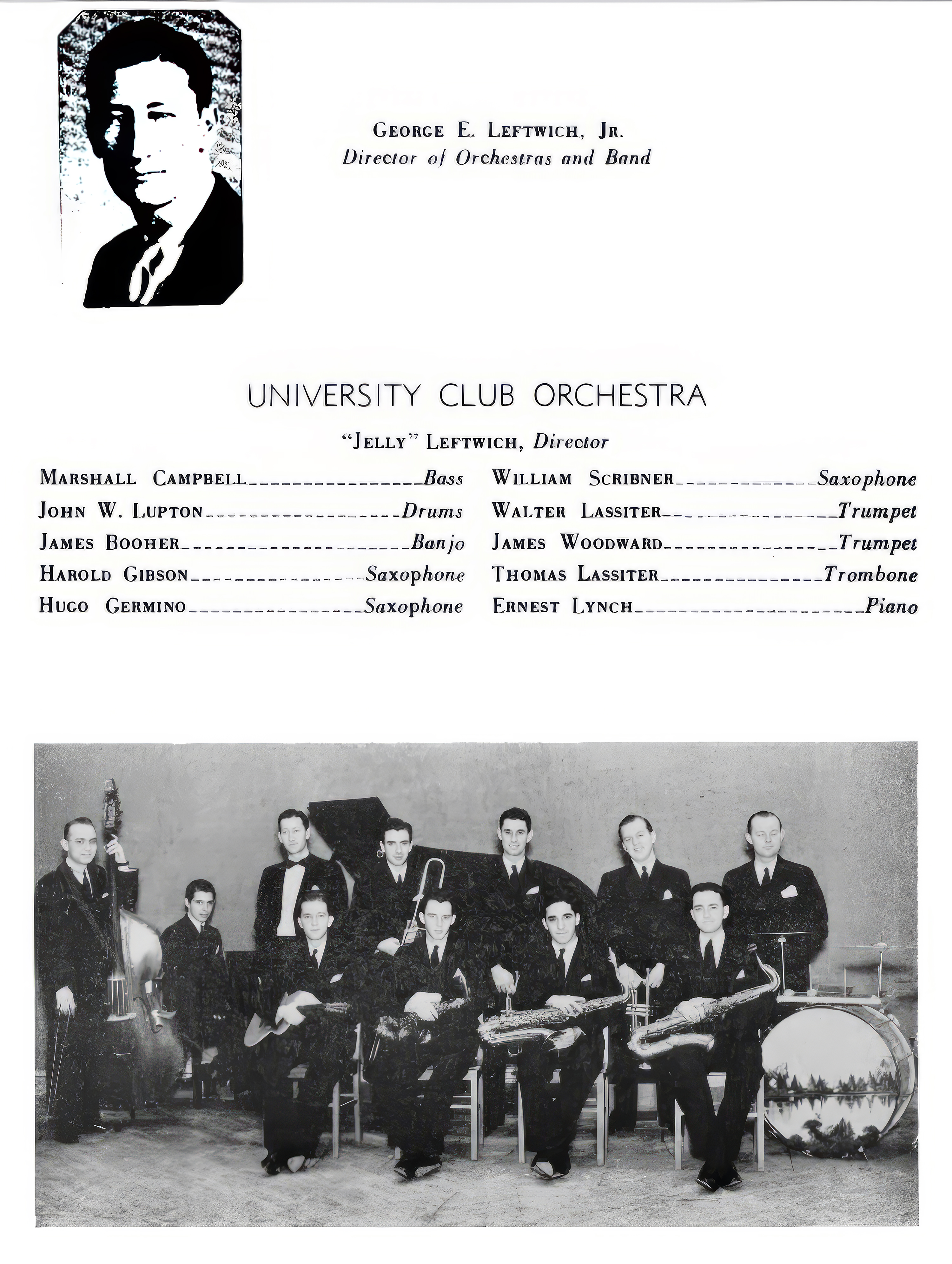
From 1926 to 1932, George “Jelly” Leftwich was the band director of Duke University, but his most popular ensemble was the jazz orchestra he formed, which I’ve seen referenced as the Duke University Club Orchestra, George Leftwich and his Blue Devils, and the Duke University Blue Devils.  At a community performance at Durham High School (now Durham School of the Arts, 400 N. Duke Street), the Duke Chronicle reported that the band played “Who,” “Tiger Rag,” and “Stumbling.”

1926, the year Leftwich started working at Duke as its first director of music, was a notable year, as the student population demanded more dancing and dance music – the student body voted 704 to 6 in favor of on-campus dancing, in an attempt to sway the Methodist-affiliated university’s administration concerning the no dancing on campus policy.  Perhaps the timing of this vote and the hiring of Leftwich/formation of the jazz orchestra were intentional, coincidental, or perhaps one bolstered the other.  Ultimately, the student body won out and dancing to both recorded and live music became an on-campus activity.

755px-Leftwich_BlueDevils
My sources say this photograph of George Leftwich and his Blue Devils was probably taken in the East Duke building – from the Duke University Archives.

On Duke’s campus during the Great Depression, student financial constraints meant that they couldn’t always make it to whatever entertainment was available downtown, so they made their own.  A gymnasium built in 1898 (nicknamed “The Ark“) was converted to more multipurpose dancing space by the Social Standards Committee of the Woman’s Student Government, who paid to have the floor refinished, purchased a radio/Victrola, and hosted bands every Saturday night and one Wednesday night per month.  In 1931, Duke University constructed the West Campus Union building, which also housed a popular ballroom where bands performed.

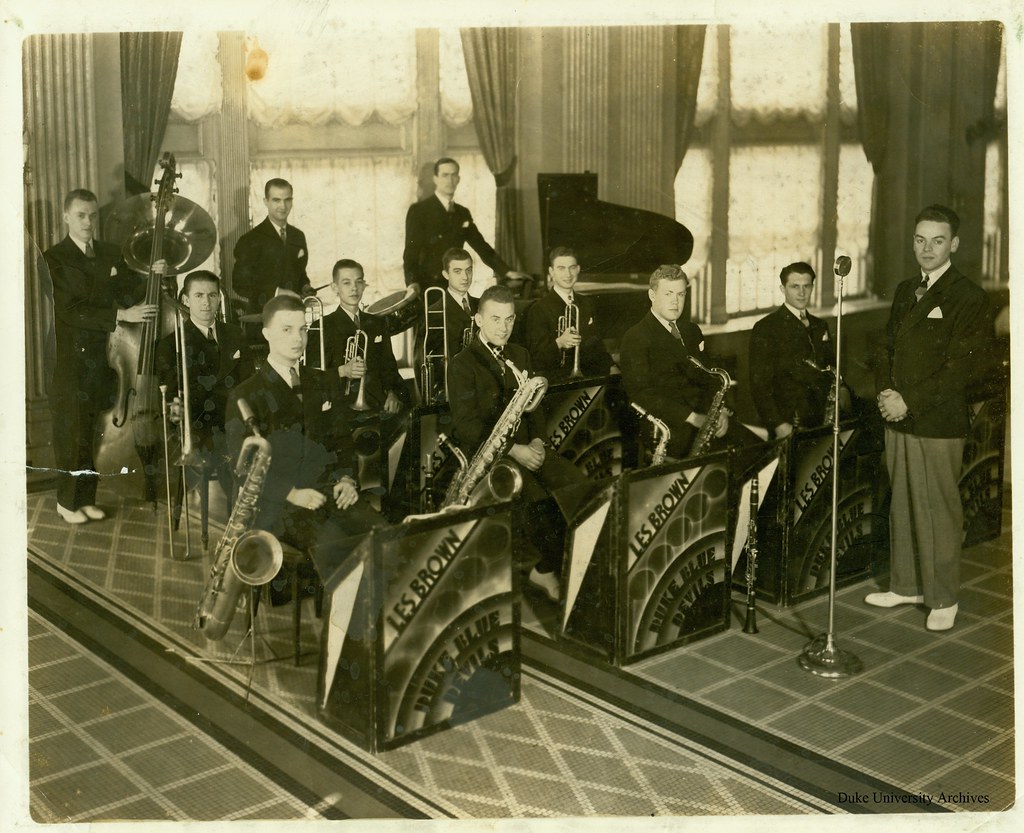
While Jelly Leftwich was successful at directing bands for Duke, his success also inspired students to start their own bands, such as the Duke Collegians (founded in 1931), Nick “the Crooning Half-back” Laney and his Blue Devil Orchestra (founded in 1932), Sonny Burke and The Duke Ambassadors (founded in 1934), and other swing bands such as the Swing Kings, Blue Dukes, Blue Imps, Grand Dukes, and the D-Men.  Laney’s band went on a summer tour of the northeast in 1932 and while on the road met an up-and-coming saxophone player named Les Brown and convinced him to come to Duke instead of the University of Pennsylvania.

In 1933, Brown took over leadership of the Blue Devils after Laney graduated.  Under Brown’s direction (while still a student), the Blue Devils performed regularly on campus and toured throughout the east coast, with their tour in 1936 being particularly successful.  They were signed by Decca Records and recorded in the fall of 1936, but disbanded the following year.  Brown moved to New York (with some of the Blue Devils coming with him to form the Band of Renown) and the rest is history.

Les Brown and the Duke Blue Devils, early 1930s
Photograph from the Duke University Archives

A final swing era note that occurred later in Duke’s history, from 1977 until her death in 1981, jazz pianist, composer, arranger, and all around badass Mary Lou Williams was a professor at Duke and led the Duke Jazz Ensemble (this was not Williams’ first experience in Durham, however – we’ll return to this later).  In 1983, Duke established the Mary Lou Williams Center for Black Culture (404 Chapel Drive) which (among many other things) continues to host jazz performance series Jazz @ The Mary Lou.

SWING ERA – TOURING ACTIVITY

roycroft_100247
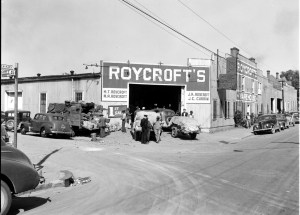
Was “In a Sentimental Mood” composed here? Photograph from Open Durham

Duke Ellington has a history of performing in Durham, with the earliest show I could find on record occurring on July 22, 1934 with his orchestra at Banner Warehouse (216-220 W. Morgan St.), roughly where the YMCA and Mr. Tire are located today.  He returned on March 13, 1935, to play a show at the Roycroft Warehouse (401 Rigsbee Ave.) from 9 p.m. to 1 a.m. (according to the Norfolk Journal and Guide published on March 9, 1935).  As the legend goes, in 1935 Ellington composed “In a Sentimental Mood” at a performance at a party hosted by the NC Mutual Life Insurance Company, composed spontaneously to calm the mood after one of his friends got in a quarrel with two women at the party.  The only record I can find of him performing in Durham in 1935 is this March 13, 1935 date, so it may be that this jazz standard was written in a Durham tobacco warehouse.  The Durham Armory (212 Foster St.) opened in 1937 and Ellington came back to Durham on September 24, 1938 to perform there.  He would return to Durham for later performances, but we are focusing on pre-war and WWII performances for the purposes of this post.

2800
Ad image from the Hi De Ho blog

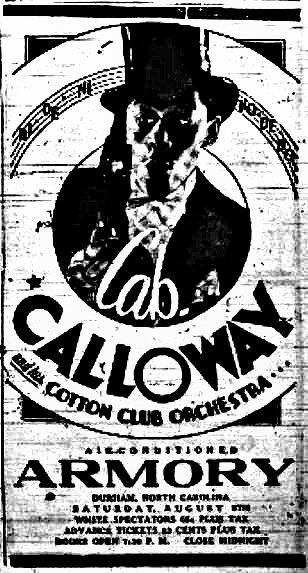
Cab Calloway was a frequent performer not only in Durham, but in other places in North Carolina during the swing era.   Calloway’s autobiography says Irving Mills and a “Mrs. Knowles” put together his first southern tour in 1931. “In Durham, NC, we played in a tobacco warehouse that was as big as Madison Square Garden, and they put a rope down the middle of the warehouse and the whites danced on one side and the Negroes on the other.” Calloway’s biography goes on to mention other Durham performances, including a March 1933 performance that was “stopped by a riot.”  On August 6, 1938, he made a stop at the newly opened Durham Armory, with the Carolina Times ad touting the Armory’s air conditioning and noting that admission for “white spectators” was $0.65 (sidebar to explain: dances and venues in Durham were segregated and there were promoters who would set up performances at the Durham Armory where Black attendees would pay for general admission – i.e. for dancing on the ground floor – and whites would pay to sit in the balcony and watch).  He returned to Durham on March 25, 1940 for a performance at City Auditorium (now The Carolina Theater 309 W. Morgan St.) for a performance the Monday after Easter.  He also notes in his biography that the band needed a white bus driver to get them hamburgers somewhere between Raleigh and Durham on Easter morning.  Calloway’s last swing era performance in Durham (that I can find) appears to have been on October 6, 1945 at the Durham Armory.

51544705_382635935617407_7195500968895578112_n

On November 26, 1937, Andy Kirk and his Clouds of Joy performed at the Durham Armory (heated), but check out whose loveliness graces the ad, even if she’s not given top billing?  As mentioned before, Mary Lou Williams would return to Durham on a more permanent basis in the 1970’s and this ad illustrates that she, even in 1937, was a respected jazz woman and a draw to audiences.  Dancing from 9:30 p.m to 1:30 a.m. – basically my perfect evening dance time frame!  Andy Kirk and his Clouds of Joy would return to the Durham Armory on February 26, 1943 and on June 23, 1943 to perform, boths times featuring June Richmond on vocals.

In March of 1938, Lucky Millinder‘s orchestra made an appearance at the Durham Armory – unfortunately, the only report available is through the lens of a white Duke student, The Duke Chronicle’s music columnist Hal Rees: “Did you notice that fine trombone soloist and section of Lucky Millinder’s at the Armory? Far above the average for a Negro band as was the alto sax who gave out quite a few boots on his horn…” (you’ll see earlier in the column where he has received complaints about said column, I’d say deservedly so).  Millinder would return at least twice more time to perform at the Durham Armory on December 25, 1942 and on June 14, 1943 (which I’ll come back to below).

In spite of Mr. Rees’ column, Duke University welcomed Earl Hines’ orchestra, featuring Ida James on vocals, also in March of 1938.

51142697_393142251248505_6364997672742420480_n
A 1939 ad from The Carolina Times, courtesy of Ken Hanson

On May 9, 1938, the Count Basie Orchestra – “America’s Newest Swing Sensation” – featuring Helen Humes and Jimmy Rushing appeared at the Durham Armory, which was their last stop before heading to New York for a week-long residency at the Apollo Theater.  Basie would return to the Durham Armory again on April 28, 1939, as shown in the The Carolina Times ad pictured here  (thanks to local dancer Ken Hanson for digging through this newspaper source material and adjusting the resolution on these already fuzzy resolution ads).  In some cases, we’ve resorted to looking at ads on buildings in photographs, such as this instances on the Open Durham blog – a photo of The Regal Theater taken in 1946 (324-328 E. Pettigrew St.) (though on the Regal Theater’s blog entry, the photo is a date range of late 30’s-early 40’s), we can see posters for Count Basie pasted to the side of this building, which I hope we can presume that Basie was actually performing at this venue – the Open Durham blog notes that Basie was among other luminaries performing at this venue, though it was predominantly a movie theater by the 1930’s.

regal_night_1947
The Regal Theater at night, 1947 – photograph from Open Durham.  The Regal Theater was owned by George and Maude Logan and was part of Hayti, Durham’s African-American community/district.
51294679_265350207693724_3682615868530884608_n
A 1943 ad from The Carolina Times, courtesy of Ken Hanson

Incidentally, internet searches for Count Basie and Durham, NC are a bit stymied by Basie sideman, composer, and arranger Eddie Durham, but then I find that Eddie Durham came to play at the Durham Armory on July 1, 1943 with “his All-Star Girls Band” (also known as Eddie Durham’s All-Star Girls Orchestra).  Due to the proximity of Camp Butner, established in 1942 as a result of World War II, and promoters such as Lin Holloway and Lathrop Warren Alston (more on him below) advertising to draw Black servicemen to shows in Durham, the service-focused All-Stars were a perfect fit for this time and place.  The All-Stars “dedicated at least one night per week on the war effort and their activities included raising war bonds, uplifting morale, and performing at military camps and USO centers.”

51368785_146232642960066_8178568907926274048_n
Carolina Times ad, courtesy of Ken Hanson

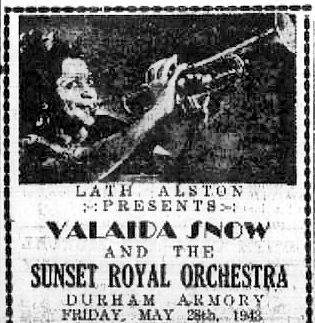
Speaking of all-girl bands of the 1940’s, the International Sweethearts of Rhythm graced the Durham Armory stage on June 4, 1943 just a few weeks before the All-Stars came into town – I can’t tell you how excited I am to know this, I only wish I could find more details!  Just a few days before the Sweethearts were in town, Valaida Snow and the Sunset Royal Orchestra performed at the Durham Armory on May 28, 1943 – yes, ladies!

Backtracking a bit, on May 15, 1940, Glenn Miller‘s orchestra performed at Duke University’s Cameron Indoor Stadium (115 Whitford Dr., built in 1939) and broadcast the performance live as part of the CBS Chesterfield “Moonlight Serenade” program.  I can’t imagine Cameron Indoor Stadium being a great acoustic space for a broadcast, but I can imagine that this was selected as the venue (over one of Duke’s ballroom spaces) due to its capacity – an estimated 12,000 people were in attendance.  To give you perspective on the attendance, the seating capacity of Cameron today is 9,314, so imagine every seat full and the dance floor (i.e. the basketball court) packed!  Of course this may have been an over-estimation, but the point is made.  As a souvenir, we have an air check of the band playing St. Louis Blues.  However, it was another recording that made me realize that Miller had performed at Duke – as I was going through uptempo tunes for competition music ideas, I came across a live recording of Miller’s orchestra playing Down South Camp Meeting, where the announcer at the beginning mentions Duke University and apologizes for something – I have no idea what the apology is for, but I’m definitely curious as to what happened!

Commencement, 1940
Duke University commencement in Cameron Indoor Stadium, 1940 – perhaps just days/weeks from the Miller concert?  Photograph from Open Durham.

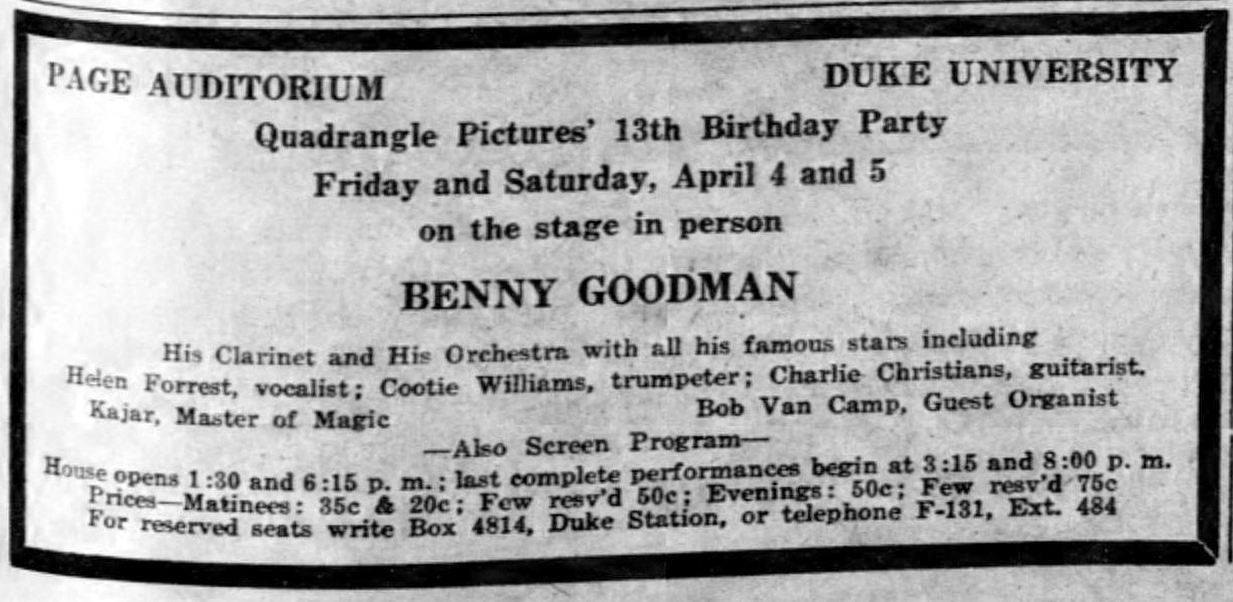
On April 4 and 5, 1941, the Benny Goodman Orchestra, featuring Helen Forrest, Cootie Williams, and Charlie Christian, performed at Duke University’s Page Auditorium (402 Chapel Drive), but also appears to have played a dance or two somewhere on campus during this time frame, as well.  The ad from The Carolina Times (courtesy of Ken Hanson) only references shows at Page Auditorium, with two matinees at 3:15 p.m. and evening shows at 8:00 p.m., featuring Bob Van Camp on organ (perhaps a Duke University senior at this time?) and “Kajar, Master of Magic” (maybe this guy?).  The Page Auditorium shows were sponsored by Quadrangle Pictures, which formed in 1928 to screen motion pictures on Duke’s campus and was celebrating its 13th birthday party with this concert series.  However, we also know from The Duke Chronicle that the Pan-Hellenic council was hosting their second dance of the year during this stop in Durham with the Goodman orchestra – if Goodman’s in town, it’s gotta be dance or bust, who wants to sit in an auditorium listening to this toe-tapping music when there are rugs to be cut?  There’s also a photo of Goodman at this dance in the university archives (included below), perhaps snapped by a student or amateur photographer, which is clearly a dance (streamers, people standing around in tuxes/formalwear in front, and people facing each other dancing in the background).  Perhaps the best thing about this photograph is Benny Goodman’s expression – did the photographer catch him off-guard or is the photographer the recipient of “The Ray,” Goodman’s infamous withering gaze?

52611734_1236012466563292_9112068522019651584_n
52696084_376396776513427_7019088464272424960_n
51672203_400076423893406_4196457672695873536_n
CarolinaTimes ad from Ken Hanson

Another aside, my Duke University searches keep getting stymied by Duke Ellington…but I digress, there are worse things… 😉

The Ink Spots were frequent performers at the Durham Armory in the 1940’s – swing dancers today don’t often dance to their music, but they were super stars, with a #1 hit with their recording of “If I Didn’t Care” in 1939, which remains one of the best selling singles of all time (9th, according to Wikipedia at the time of this post).  Fresh off their hit single, the Ink Spots first performed at the Durham Armory on March 8, 1940 and returned on June 20, 1941.

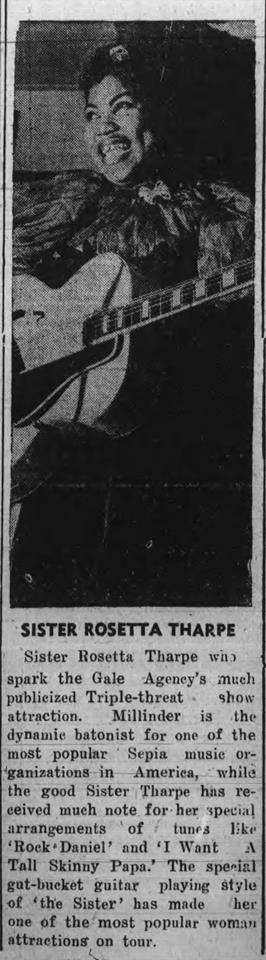
On June 14, 1943, the Ink Spots were slated to play a double bill with Lucky Millinder, featuring Sister Rosetta Tharp, at the Durham Armory.  All the musicians were staying at the Biltmore Hotel (330-332 E. Pettigrew St., one of the preeminent hotels catering to African-Americans in the southeast during the swing era, so the likely place for traveling big name bands and musicians to stay) and it was here that things started to go horribly wrong for Lucky Millinder before the show even started.

51562111_10158108843358154_2583750053512347648_n
The Carolina Times headlines, courtesy of Kirk Eisenbeis
51454867_10158108916798154_8243935398183567360_n
Ad from The Carolina Times, courtesy of Kirk Eisenbeis

From The Carolina Times, dated June 19, 1943: “Orchestra Head Gets Cut in Argument Over Room, by Joseph Hopson.  In a fracas staged in front of the entrance of the Biltmore Hotel, Lucky Millinder was seriously stabbed in the right hip by a woman companion of one of the Four Inkspots here Monday afternoon.  The brawl is said to have arisen by Millinder arguing with the woman over his having rented the best rooms in the hotel for his bandsmen.  The woman hailed a passing taxi-cab and went to the uptown section of Durham where she purchased a knife and returned and proceeded to cut Millinder without warning.  By-standers finally succeeded in wresting the knife from her hands, but not before she had seriously cut Millinder in the right leg, severing an artery.  Millinder was unable to appear with his band in the Durham engagement.  The Inkspots left the show crew in Durham after the engagement at the Armory, but appeared with them in Raleigh on the following night.  According to bandsmen, Millinder is doing “fair” at present.”

I have so many questions about this incident that will never get answered.  We know Millinder made a recovery and remained active in music until the 1950’s, so that’s good, but who is this mysterious companion of the Inkspots?  What the heck did Millinder say to her?  Were the hotel rooms really worth it or was this about something else?  Did Millinder’s band do the show without him?  If so, can you imagine the tension on stage?  Just…wow.

From May 3 through June 29, 1944, the Ink Spots went on tour with Ella Fitzgerald and Cootie Williams and his Orchestra, stopping at the Durham Armory on June 8.  Sharing the bill with them at the Armory were Moke & Poke (some sort of act from New York?), Eddie Vinson, and Ralph Brown (maybe the tap dancer?) – this must have been a big show!

The last performance for the Ink Spots at the Durham Armory that I can find is February 1, 1947, appearing with Johnny Otis and his Orchestra.

51492336_1064263677104833_683410179617718272_n

On April 6, 1942, Claude Hopkins and his Orchestra performed on Easter Monday (was this a local tradition? See above, Cab Calloway performed on Easter Monday in 1940) at the Durham Armory, featuring Belle Powell.  It looks like the promoter for this concert was the Auspices Junior Auxiliary of Lincoln Hospital, which means this show may have been a fundraiser or benefitted the hospital in some other way. Founded in 1901, Lincoln Hospital was the first hospital in Durham to provide care to African-Americans and a nursing school was established there in 1905.  The Junior Auxiliary, at least in 1938, was focused on the children’s ward of the hospital, purchasing equipment and supplies, acting as hostesses at events, and decorating and providing children at the hospital presents at Christmas.

51366383_1041633119371478_4440763671714463744_n
The Carolina Times ad, courtesy of Ken Hanson

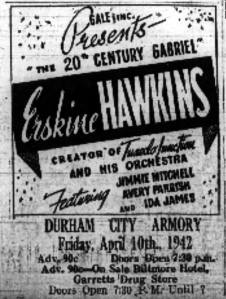
Erskine Hawkins, “creator of Tuxedo Junction” / “the 20th Century Gabriel” and his Orchestra  performed at the Durham Armory on April 10, 1942, along with Jimmie Mitchell, Avery Parrish, and vocalist Ida James.  Note at the top of The Carolina Times ad to the left the “Gale Inc. Presents,” designating that this is a Moe Gale talent booking – this is not the only Moe Gale reference I’ve seen in my research, so it appears there is a direct link between this co-founder of the Savoy Ballroom (and the bands performing there) and the shows and bands being booked at the Durham Armory.  Also, note that the time is listed as “7:30 P.M. – until?”  I wonder if they also stayed up dancing until 4:00 a.m. like today’s swing dancers…

Hawkins would return to the Durham Armory for another show on April 16, 1943 and made a radio appearance on WDNC prior to the show.  WDNC was Durham’s first radio station, going on the air in 1934.  At the time of Hawkins’ appearance, he would have only had to go around the corner from the Armory to 138 E. Chapel Hill Street to get to the radio station.

52723206_497336827462087_4381253730142519296_n

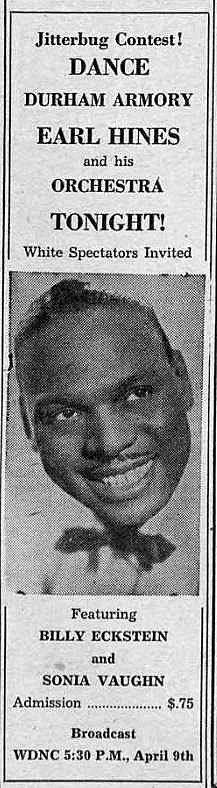
Just a few days later on April 19, 1943, Earl Hines and his Orchestra featuring Billy Eckstine and Sonia Vaughn would appear at the Durham Armory, also with a radio appearance on WDNC prior to the show.  There was no Sonia, this was a terrible typo – it was actually Sarah Vaughan, who had been “discovered” in the fall of 1942 at the Apollo Theater’s famous amateur night and had just replaced Earl Hines’ previous female vocalist on April 4, 1943.  Vaughan was initially hired as a pianist for the band (though she also sang) so that she could be under the jurisdiction of the musicians union rather than the singers union, so the Armory crowd may have heard Vaughan on piano and vocals.  The Carolina Times ad for this performance leads with “Jitterbug Contest!” – this is the only reference to a swing dance contest I’ve come across in these Carolina Times ads and I, of course, would love to know the format, what song was/songs were played for the contest, the tempos, all these things lost to time that I will never glean from these two magic words in a newspaper ad.  One thing we do know is that this show would have been awesome and a dance contest with live music by Earl Hines’ Orchestra would have been a dream!

51697129_2147037332276941_5328526977936654336_n

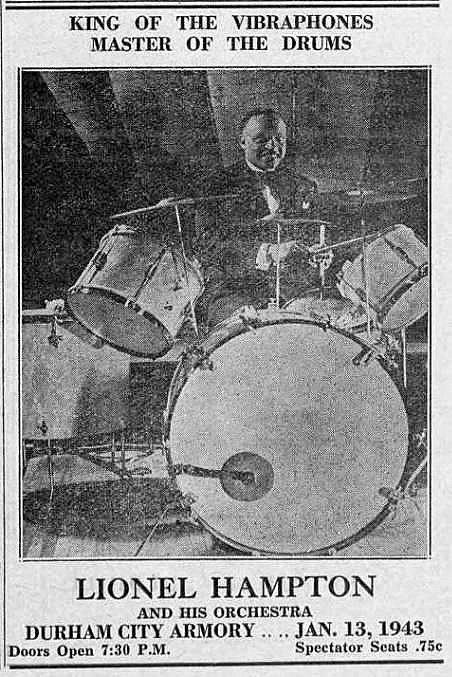
One of my favorite bandleaders, Jimmie Lunceford, and his orchestra performed at the Durham Armory on November 27, 1942 and again just a few months later on March 11, 1943.  On January 13, 1942, “King of the Vibraphones Master of the Drums” Lionel Hampton performed at the Durham Armory.  On November 19, 1943, Oran “Hot Lips” Page performed in Durham at an unknown venue.  On December 27, 1943, Buddy Johnson made an appearance at the Durham Armory, presented by Latha Alston. I also found a source that says Louis Jordan performed at the Durham Armory in the 1940’s, but doesn’t provide a date.  Sadly, I can’t find any other information about these performances in Durham, but it looks like the early 1940’s were great years for live music in Durham!

royalknightskingdavid_1922
Royal Knights of King David Hall in 1922, from Open Durham

One of the most prolific promoters I’ve seen in these source materials is Lathrop Warren Alston (also seen in sources as Latha, Lath, and Lathe, as well as with the last name Austin, however this is probably a typo since Alston is an old Durham family name).  Alston got his start promoting dances in the 1920’s at the Royal Knights of King David Hall (702-704 Fayetteville St.). It is clear that Alston was great at this work, moving on to larger venues and big name acts, having a hand in some of the tobacco warehouse concerts (given the Royal Knights’ connection to NC Mutual Life Insurance, I’m curious to know if he promoted that famous “In a Sentimental Mood” concert).  His success is apparent in the sheer number of concerts where his name is associated, particularly at the Durham Armory, given the limited resources I’ve been able to locate online – he is credited here (and elsewhere) for concerts with Cab Calloway, Duke Ellington, Earl Hines, Guy Lombardo, Fats Domino, and Les Brown.  Alston went on to become the manager of the Biltmore Hotel (330-332 E. Pettigrew St.), where he continued to feature live music, such as concerts with Ella Fitzgerald, Nat “King” Cole, and the Ink Spots.  I see that William A. Marsh, III (who I know as Judge Marsh, former Durham County District Court Judge) is credited as the source material on Alston, so I’ll have to ask him about it at some future Durham Bar function.

Regal_Biltmore_SE_1920s
The Biltmore Hotel and Regal Theater in 1946, with the Count Basie posters pasted on the wall to the right, photograph from Open Durham.
dick gable 3
Photograph from Open Durham

DIXIELAND REVIVAL

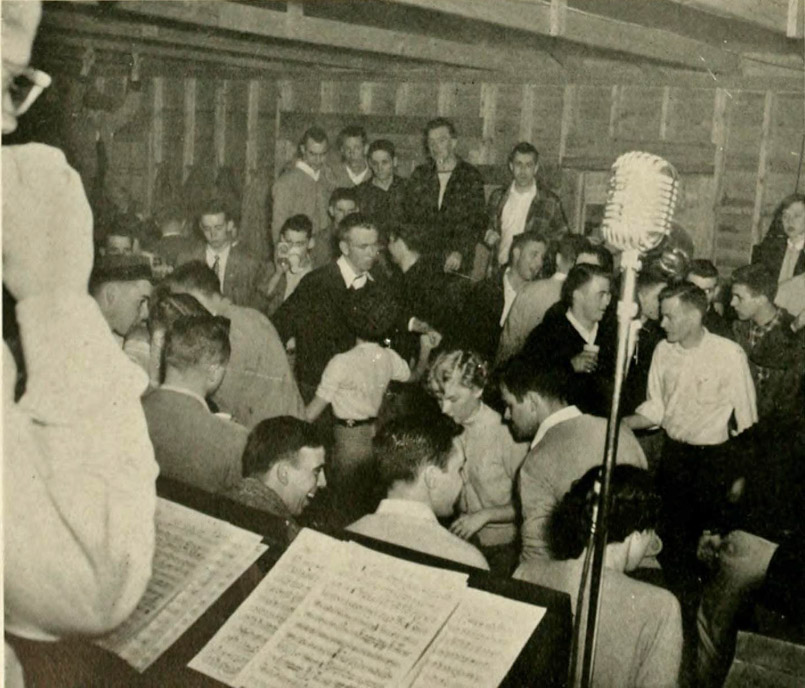
I wasn’t going to go past WWII, but I couldn’t resist posting about Turnage’s BBQ Restaurant (608 Morrene Road), where after WWII you could catch “Jazz at Turnage’s” – trad jazz/Dixieland jam sessions, performances, and dancing, in addition to some classic North Carolina BBQ.  The photograph below (the real reason I’m posting about this – dance evidence!) is from 1952, quoting Open Durham: “It was evidently popular with Duke students as well – the picture is from the Duke Chanticleer, captioned “JAM SESSIONS, featuring Dixieland Jazz Combo and some fast jitterbugging, shook the rafters on Saturday afternoons of spring semester.”

turnages_interior_1952
Durham jitterbugs in 1951 – photograph from Open Durham

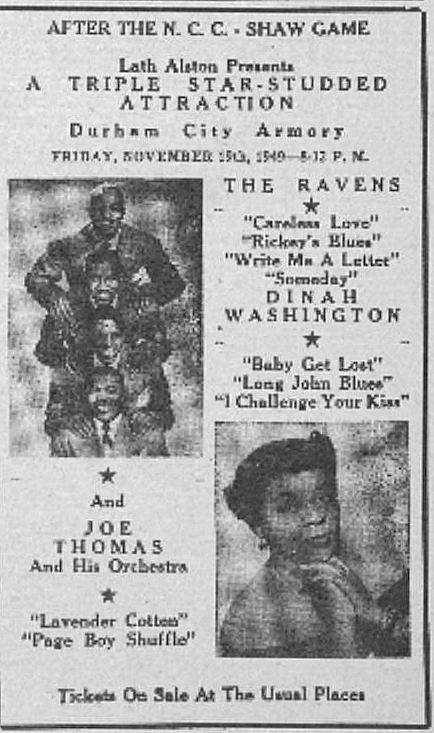
I am certain there is much more information about swing bands, dancing, and related local culture that I have not found in my online searches, but I feel like this is a solid start.  Perhaps the most glaring omission are Durham-based hot jazz and swing bands (that perhaps did not reach the level of fame as those touring bands herein) outside of those formed by students at Duke University – if you have any leads or other sources of information, please feel free to leave them in the comments below!  I’ll leave you with an ad relevant to my recent musical performance interests (but after the time frame of this post) and some more ads I couldn’t fit into the text of this post (all courtesy of Ken Hanson).

Addendum 5/25/19: You can listen to about 15 minutes of the May 15, 1940 Glenn Miller broadcast from Duke University at the Star Spangled Radio Hour podcast’s 4/14/18 episode, starting around time stamp 1:22:25.  Thanks to Ken Hanson for the additional link!

Addendum 7/21/23:  Tom Lassiter, father of Mint Julep Jazz Band guitarist Ben Lassiter, reached out to me recently (after I shared this post in anticipation of Flying Home 2023) to share the following: “Ben never met his great-uncle, Walt Lassiter. My Uncle Walt died a couple of years befoe Ben was born. Both he and my father learned to play trumpet while in school bands in Smithfield, NC. Their first cousin, Tom, played trombone. By the early 1930s, Walt and Tom were at Duke and still playing their horns. I have vivid memories of Walt talking about playing with “Jelly Leftwich and his orchestra,” especially summer gigs at the Lumina at Wrightsville Beach. Your recent mention of Durham’s musical heritage reminded me of all that. Here’s a page from Duke’s yearbook, The Chanticleer, 1932 edition. In the photo, Tom is holding his trombone. Walt is beside him, standing third from right.